
One and a half minutes.
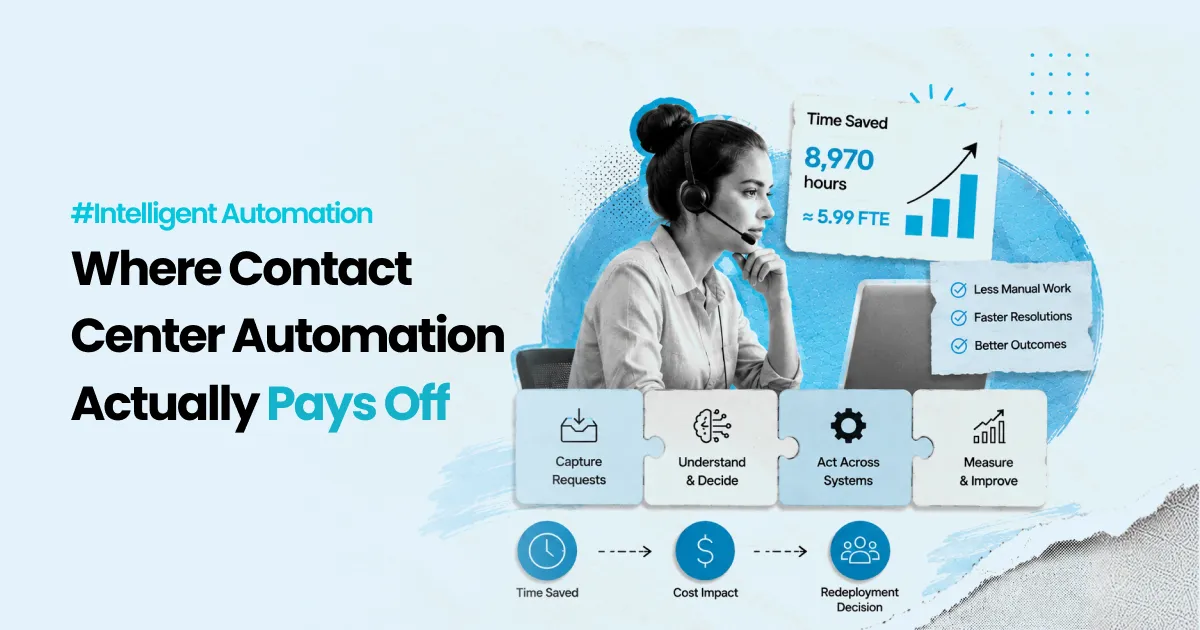
That is what generated summaries take off the after-call work on a single voice contact in the model further down this page. It sounds too small to chase. Across a sixty-seat operation handling 358,800 contacts a year it comes to 8,970 hours, which is just under six full-time equivalents.
Six people’s worth of time, and none of it is money yet.
It becomes money only if somebody decides in advance what those six people will do instead, and then makes sure it happens. That decision is usually nobody’s job. It is the reason contact centre automation programmes report savings finance cannot find, and it is the thread running through everything below.
So this is not a tour of features. It is the work ordered by where the money actually is, the four places it gets stuck, and the three numbers that decide whether any of it pays.
Start where the time goes, not where the demo starts
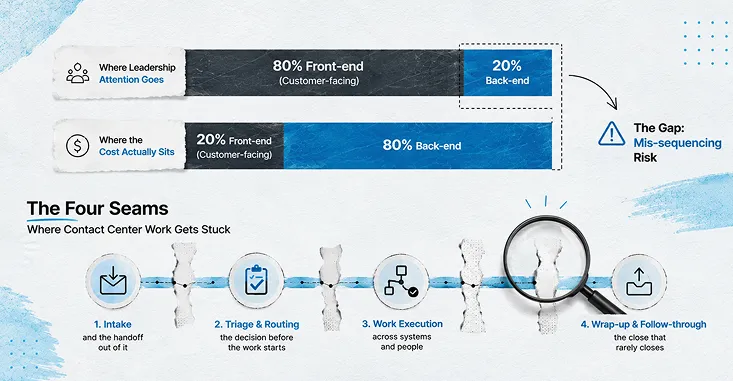
Vendor demonstrations open with the conversational interface, because that is the part that looks like the future. Cost sits somewhere less impressive: in the minutes after the customer has hung up, and in the manual steps between systems that nobody designed and everybody works around.
That mismatch is the first decision, and getting it backwards is expensive. Front-end automation touches every contact and carries reputational risk on each one. Back-end automation touches the same volume with almost none, because the customer has already gone. If you are going to be wrong somewhere, be wrong where the customer cannot see it.
One caution before picking a target, and it is the reason to map the work before shortlisting tools. Occasionally the workflow that scores highest on automatability is holding up something that is not operational at all: a compliance record, an audit trail, a judgment call that someone downstream depends on being made by a person. Automating it improves every figure on the dashboard and quietly removes the thing the business was relying on. No dashboard can show you that trade, which is why somebody has to go looking for it while the build is still cheap to cancel
Map one high-volume workflow end to end before anything else: the trigger, the systems it crosses, the decisions a human makes and why, the exception paths, and the steps where being wrong causes harm. Teams that do this honestly all report the same finding. The pain is concentrated in the glue between systems, not in the systems themselves.
The four seams where contact centre work gets stuck
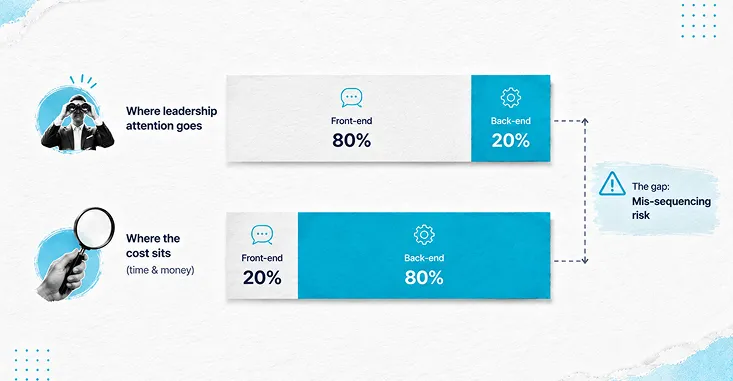
Work does not get lost inside systems. It gets lost passing between them, and between the people and software either side of a handoff. There are four such seams in a contact centre. Each one has automation worth doing, a way that automation flatters itself, and something specific you can sample to find out which is happening.
Seam one: intake, and the handoff out of it
Customers like self-service when it resolves the thing. They hate it when it holds them. Virtual agents handle status checks, policy questions and basic troubleshooting well; knowledge search works when it matches the customer’s own words rather than the taxonomy your content team built.
The stakes at this seam are rising on a documented timeline. Gartner’s published guidance on customer service artificial intelligence (AI) states that by 2028, at least 70% of customers will use a conversational AI interface to start their customer service journey. Read that as a claim about the front door, not about resolution. If most journeys will begin in a conversational interface, the quality of the exit from that interface becomes the thing that determines customer experience.
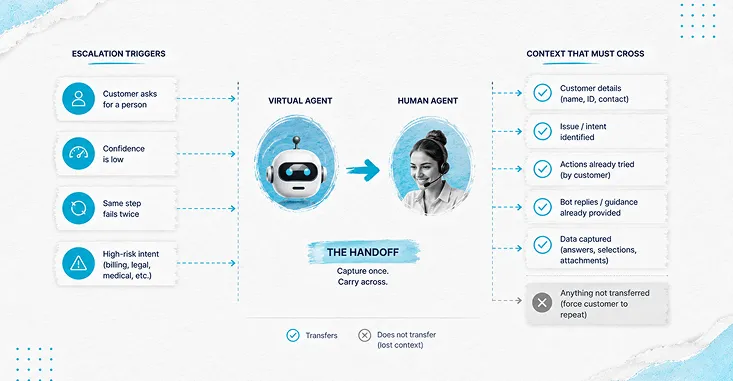
Which means the escalation rules are the design, not an afterthought. Define the triggers explicitly: the customer asks for a person, confidence is low, the same step fails twice, or the intent carries risk such as a billing dispute, a legal request, or anything medical. When escalation fires, the agent should receive what the customer already tried, what the bot already told them, and what data was already captured. Most failures blamed on the bot are failures of what did not survive the handoff
How this seam flatters itself: containment. A contact that resolves nothing but produces a callback tomorrow is not contained, it is postponed, and postponement and resolution look identical on a containment dashboard. Read containment only ever alongside repeat contact rate inside 72 hours.
What to sample: fifty escalated contacts, checking whether the agent could see the bot transcript without asking the customer to start again.
Seam two: the routing decision
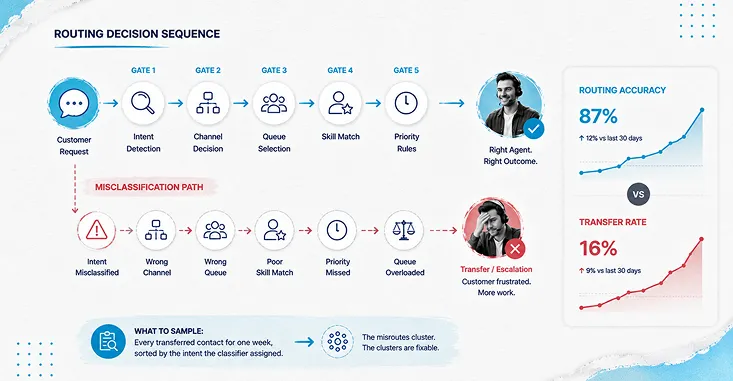
Routing is not only which agent answers. It is a sequence of decisions about channel, queue, priority, skill match and what happens next. Automation earns its place in intent detection, where even coarse classification stops “I want to change my delivery address” landing in general support; in skill matching; in priority rules for regulated complaints, account security and time-critical delivery problems; and in load balancing, so a queue spike does not need a supervisor watching it.
How this seam flatters itself: routing accuracy. Aggressive skill-based routing raises first contact resolution on the contacts it classifies correctly while generating transfers on everything it does not, and the two effects can cancel out while both dashboards look busy. Pair routing accuracy with transfer rate and read them as one number.
What to sample: every transferred contact for one week, sorted by the intent the classifier assigned. The misroutes cluster, and the clusters are fixable.
Seam three: the agent’s desktop
Most leaders talk about deflection. Several of the largest wins come from supporting the person instead: customer context, recent history, the relevant policy line, the next best action, a draft reply. Less searching, fewer mistakes, more consistency between agents.
One rule outranks the feature list. Assistance has to appear inside the application the agent already has open. A second window is a tax, and agents will route around a tax.
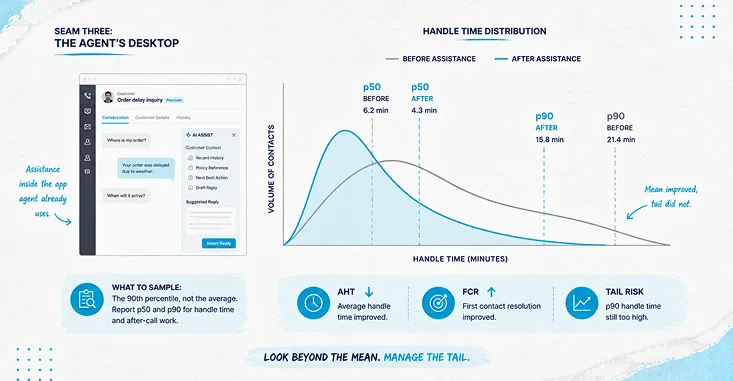
How this seam flatters itself: average handle time (AHT). Time falls because agents stop doing something, and sometimes the thing they stop doing was the explanation that prevented the next contact. Pair handle time with first contact resolution (FCR), and watch adherence too, because assistance that requires reading slows the tail even while it lowers the mean.
What to sample: the 90th percentile, not the average. Report after-call work and handle time at both the median (p50) and p90. The mean hides the tail, and the tail is what produces overtime and complaints.
Seam four: after the contact ends
Case notes, tagging, follow-up mail, customer relationship management (CRM) updates, back-office dispatch, record updates. This is where the money is, and it is the safest place to start, because the rules are clearer, the systems are internal, and approvals can contain the risk.
Begin with work that is repetitive, rule-based, high volume and easy to check: creating a ticket with the right category and mandatory fields, updating a status and next action, generating a pre-filled form, attaching an order status to a case, raising a refund request with correct metadata.
Robotic process automation (RPA) earns its keep here. Contact centre platforms and CRMs are frequently not connected all the way, and where application programming interface (API) coverage stops, a software robot is often the most durable bridge available. That is a judgment about integration surface, not a preference about tooling
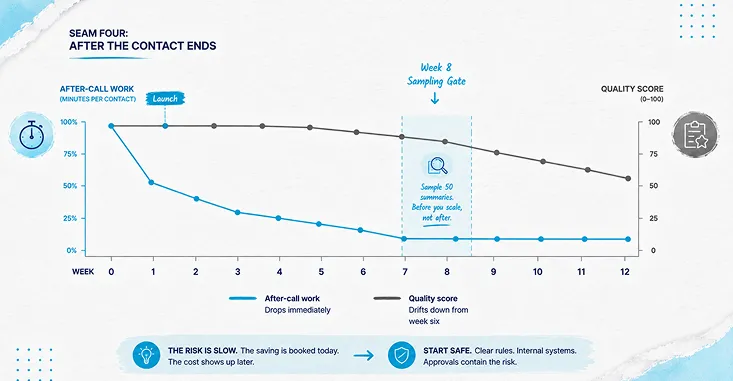
How this seam flatters itself: and this is the one that costs the most, because it is slow enough to escape attribution. After-call work drops the week you launch. Quality scores start sliding about two months later. The generated summaries are fast and grammatical and thinner than what an experienced agent wrote, so the next agent to pick up that customer has less to work with. The cost does not land on the team that booked the saving. It lands in quality assurance and on the escalation desk, and it arrives late enough that nobody links it back
What to sample: fifty generated summaries at week eight, read against agent-written notes on comparable contacts from before launch. Do it before you scale, not after.
The three numbers that decide whether it pays
Most business cases present a return and hope nobody probes it. It is more useful to go the other way and state the three thresholds the programme has to clear, because those are the numbers that will actually determine the outcome. Everything here is illustrative; the point is the structure, and your own figures belong in it.
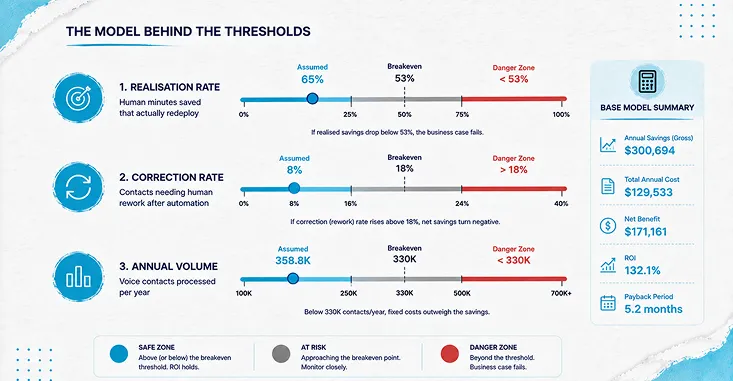
Threshold one: realisation, 43.1%
Saved minutes are not saved money. They become money when they convert into handled volume, reduced overtime, or fewer seats, and not before. The model below returns 8,970 hours a year. At full conversion the return is 132.1%. Convert 70% of it and the return is 62.5%. Convert half and it is 16.1%. Below 43.1% the programme costs more than it saves, and 43.1% is easy to miss when time comes back in thirty-second fragments nobody can reschedule.
This is the threshold with a named owner or no owner at all. The version that works sounds mundane when you hear it. A wholesale distribution business we support had its internal technology team pinned down by day-to-day development requests, and the arrangement its technology lead now describes is that routine build work is absorbed elsewhere so his own staff spend their time on high-value exceptions. That is realisation expressed as a destination for freed capacity, decided before the capacity existed rather than discovered afterwards. Write down the equivalent sentence for your own programme before you build anything.
Threshold two: correction rate, 29.3%
The model assumes agents substantially rewrite 8% of generated summaries, taking 2.5 minutes when they do. Raise that to 25% at 3.5 minutes and the return falls from 132.1% to 23.9%: still positive, and roughly one sixth of what was promised. Solve for where it dies and, at 3.5 minutes a correction, the programme breaks even when 29.3% of summaries need substantial rework.
That number is measurable from week one, which makes it the earliest reliable warning you can get.
Threshold three: volume, 11.2 contacts per agent per day
Fixed costs need volume underneath them. This configuration needs 154,564 contacts a year to cover its own cost, which is 11.2 contacts per agent per day against the 26 assumed. Comfortable here, and the reason to check is seasonality: a programme sized on peak can fall through its own floor in a quiet quarter.
The model behind the thresholds
Sixty agents, voice only, 26 contacts each per day, 230 working days, so 358,800 contacts a year. One unit of work is one voice contact.
Labour at $52,000 fully loaded. Take 2,080 paid hours, subtract 28% shrinkage for leave, training, breaks, coaching and adherence, and 1,497.6 productive hours remain. That is $34.72 an hour, $0.578704 a minute. Keep the long decimal in the calculation and round only on the page, otherwise the totals will not survive anyone checking them.
After-call work runs at 2.6 minutes on average, p50 of 2.0 and p90 of 4.5, so $1.5046 a contact and $539,861 a year. After summarisation the agent still reads and edits, 0.9 minutes, plus 0.2 minutes averaged across all contacts for the 8% needing rework, giving 1.1 minutes of human time at $0.6366, plus $0.03 run cost. Saving of $0.8381 a contact, or $300,694 gross.
Against that: $85,000 build amortised across three years at $28,333, licensing at $110 per agent per month at $79,200, support and maintenance at $22,000. Total $129,533. Net $171,161, a return of 132.1%, payback in 5.2 months.
The thresholds above are what that model looks like from the side. They are the version to take into a leadership meeting, because a room can interrogate a condition and can only nod at a percentage.
A 90-day sequence that protects the baseline
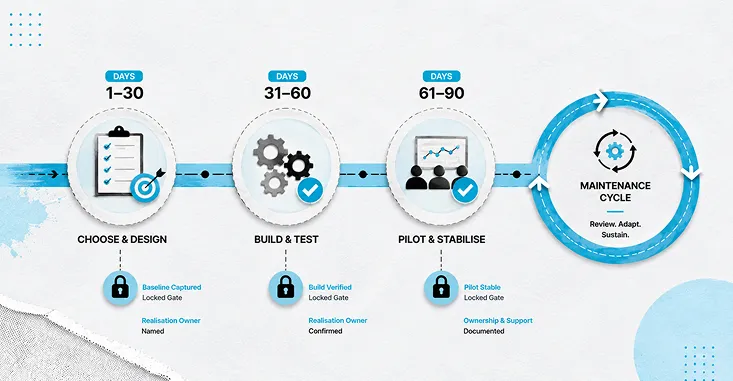
Days 1 to 30, choose and design. One workflow. Map systems, steps and exception paths, define escalation rules, and capture the baseline before touching anything, because a baseline measured after go-live is not a baseline. Name the person accountable for realisation and write down where the freed time is going.
Days 31 to 60, build and test. Build the components and the back-office chain. Test against real historical cases, including the ugly ones, not a curated set. Turn on logging and review now rather than retrofitting it.
Days 61 to 90, pilot and stabilise. A small agent group first. Tune weekly. Tighten escalation as the failure patterns emerge. Document ownership and support before the project team disbands.
That last clause is doing more work than it looks. Automations do not fail loudly; they decay. A source system renames a field, a policy shifts a threshold, an exception path that used to catch 2% starts catching 9%, and the automation keeps completing and keeps reporting success, because success was defined as finishing rather than as being correct. Fund the review cycle in the original business case or the programme becomes a liability that still shows green.
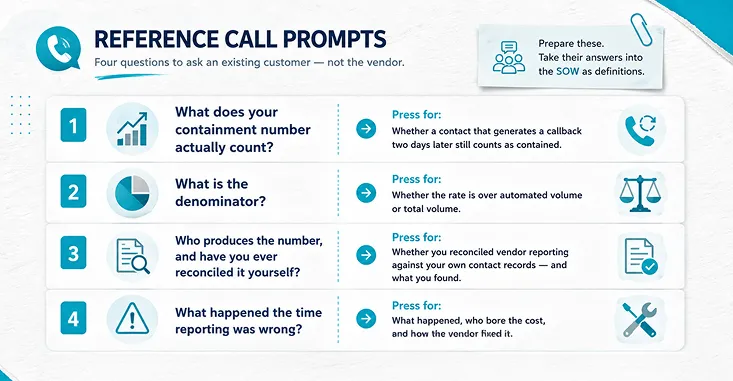
Four questions for the reference call, not the vendor
Every vendor will answer questions about their own product well. The useful conversation is the one with an existing customer, and it is worth preparing for. Ask these four.
Take the four answers into the statement of work as definitions. Definitions agreed after go-live are negotiations, not definitions.
Where a platform like NICE CXone fits
Contact Center as a Service (CCaaS) is a cloud model that delivers contact centre capability across voice and digital channels, usually bundling routing, workforce management, analytics and integrations rather than leaving you to assemble them.
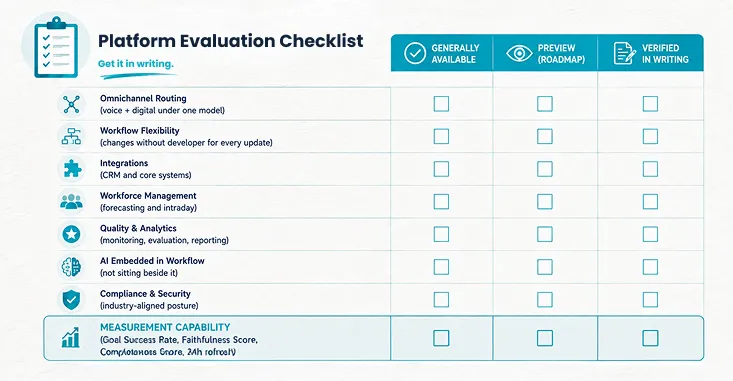
PAteam implements NiCE CXone, so read this as a partner’s view rather than neutral analysis. The criteria matter more than the badge: omnichannel routing under one model, workflow changes that do not need a developer every time, integration with your CRM and core systems, workforce management covering forecasting and intraday, quality and analytics, AI that attaches to a workflow instead of sitting beside it, and a compliance posture that matches your industry.
The measurement question deserves its own line in the evaluation, and it is worth understanding how far the category has moved. On 24 April 2026 Amazon Web Services added metrics to Amazon Connect specifically for judging AI agent performance, and the administrator guide definitions repay reading whatever platform you run. Goal Success Rate scores each session on four dimensions: whether the agent achieved the customer’s primary objective, whether the outcome was accurate, whether every part of the request was addressed, and whether the tools chosen were appropriate. Faithfulness Score checks each response against the conversation and the tool results for accuracy of representation, consistency, supported inference and correct attribution, which is how fabricated detail gets caught.
Three details in that documentation are worth more than the metric names. The scoring is performed by an automated evaluation using a large language model to read the conversation trace, so the measurement layer shares a failure mode with the thing it measures. The metrics refresh every 24 hours, making them a review instrument rather than an alarm. And Completeness Score counts only what the agent said before the customer’s next message, so resolving something later does not count retroactively, which is a deliberately strict choice and exactly the kind of definitional decision you want to know about before it appears on a slide.
So ask every vendor which of the metrics you care about are generally available and which are in preview, and get it in writing. The measurement capability you need to defend a business case is often the least finished part of a platform, and that holds across the category, including the one we implement. A platform decision does not substitute for workflow design; it makes workflow design possible, which is why implementation quality matters as much as the licence.
Fewer seams, not more bots
The contact centre is where customers meet the business, so it is where broken workflows show up first. Automation delivers there when it removes handoffs rather than adding software: safe intake, routing that holds up, assistance inside the tool the agent already uses, lighter after-call work, clean back-office steps, and an operating model that survives the launch team leaving.
There is a public standard for the governance side of this, and it is more useful than asserting good practice on your own authority. The National Institute of Standards and Technology published its AI Risk Management Framework, AI RMF 1.0, on 26 January 2023, and the framework is currently being updated. Its Measure function opens by requiring that metrics be chosen starting from the most significant risks, and that the risks or trustworthiness characteristics which will not, or cannot, be measured are properly documented. The accompanying playbook is blunter still: document the characteristics that will not be measured, including the justification for not measuring them.
Almost nobody does this, and it is the fastest way to find out whether a rollout plan is honest. Write the list. Quality drift you have not instrumented yet, downstream rework you cannot attribute, the summaries nobody is sampling. A programme that can name what it is not measuring is being run. One that cannot is being reported.
Which brings it back to where this started. You already know your after-call work average, and you can work out what six people’s worth of returned time would be worth to you.
So who in your organisation would own turning it into something, and do they know that yet?