
Why Hire an RPA Consulting Firm Instead of Building Inhouse

Why Hire an RPA Consulting Firm Instead of Building Inhouse

The IT Director has just been handed a budget. Twelve months of headcount, a tooling allocation, and a board-level mandate to “stand up an internal RPA capability.” On paper, this is a win. In practice, sitting at their desk on a Thursday afternoon, they are quietly working out whether they have just inherited a problem that nobody else in the executive team wanted to solve.

That feeling is the right instinct.

The question of why hire an RPA consulting firm instead of building inhouse is one of the most consequential decisions a COO or CIO will make in the first phase of an automation program. The wrong answer is rarely catastrophic in month three. It is catastrophic in month eighteen, when the bots are unstable, the team is half-staffed, and the ROI case looks nothing like the slide deck that got it approved.

Here is what we actually think, based on nearly a decade of enterprise delivery: building RPA inhouse sounds cheaper until you factor in the twelve months it takes to get a developer genuinely productive and the cost of the bots that break in the meantime. The hidden cost of inhouse is not the salary line. It is the time it takes to build the muscle, and what fails while you are building it.

This post answers when inhouse makes sense, when it doesn’t, and what good actually looks like.
What the Inhouse Pitch Usually Leaves Out

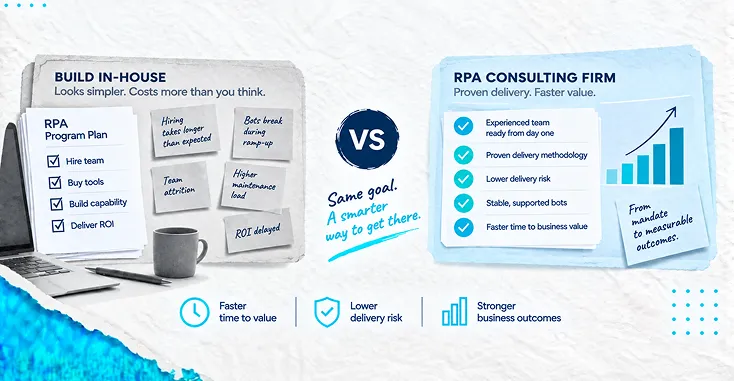
The inhouse business case typically lands on a CFO’s desk looking very clean. Two developers, a process analyst, a part-time architect, an annual RPA license, and a project manager. Total cost on paper looks reasonable, especially compared to a consulting proposal that runs three or four times that number on the surface.

The problem is that the inhouse business case is built on the wrong assumption. The assumption is that hiring an RPA developer is the same as hiring any other developer. It is not.

A genuinely productive RPA developer is not a person who knows the tool. They are a person who knows the tool, has built bots that survived three system updates, has handled production exceptions at 3am, has worked through a real PDD-to-SDD transition, and has watched at least one of their own automations fail in a way that taught them something.

That person does not exist on the open market in most regions. You either hire them from another consulting firm at a significant premium, or you build them, which takes around twelve months from a strong starting point.

The inhouse plan rarely accounts for the cost of the bots that get built, deployed, and broken during that twelve-month learning curve.

Learn how PAteam manages production RPA at enterprise scale.
Why Hire An Rpa Consulting Firm Instead Of Building Inhouse

The Real Cost of RPA Managed Services vs In-house Team Costs

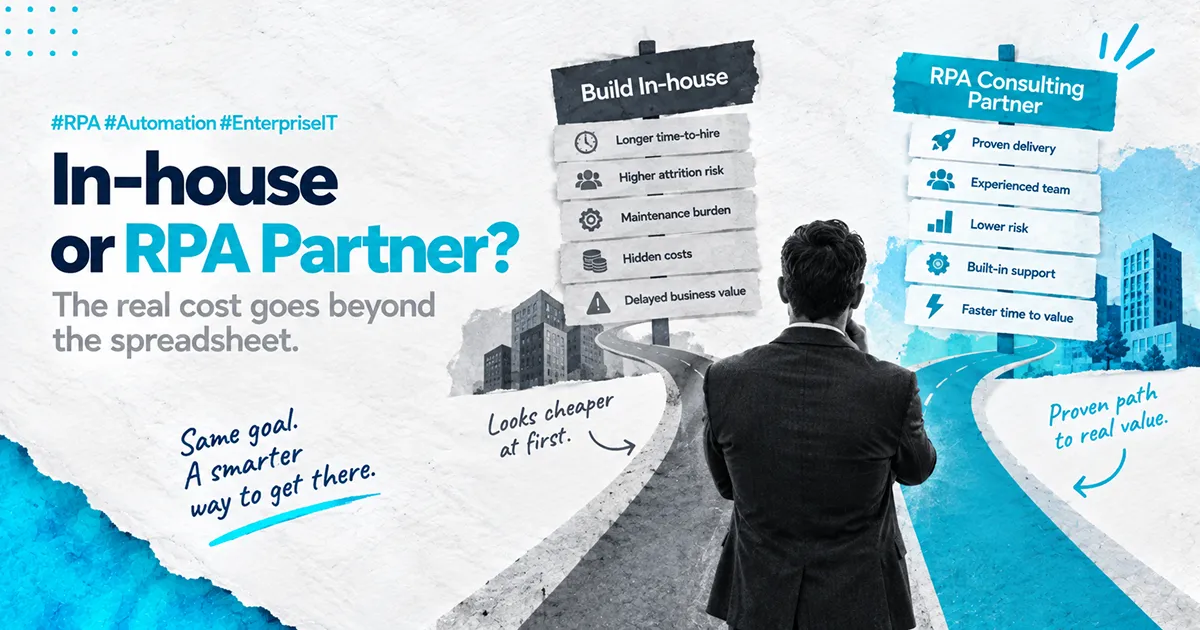
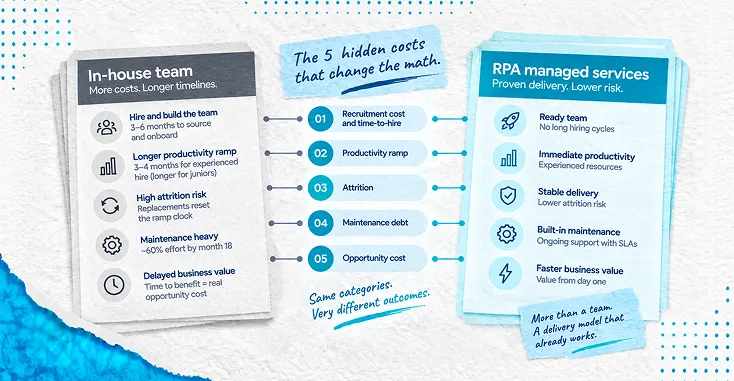
Most direct cost comparisons between an internal team and a managed RPA partner come out close. The line-item math looks similar. The gap is in the cost categories that never make it into the spreadsheet.

There are five.
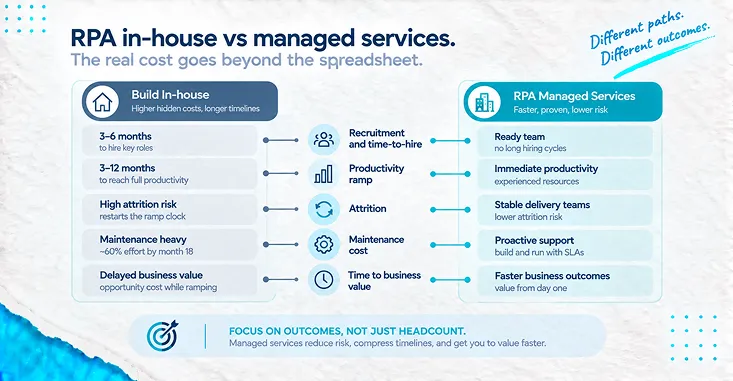
Recruitment cost and time-to-hire. A senior RPA developer in most enterprise markets takes three to six months to source, interview, offer, and onboard. That is six months of program time burned before any bots are built. Multiply by every role on the plan.

Productivity ramp. Even an experienced RPA developer hired into a new business takes three to four months to understand the systems, the data, the processes, and the politics well enough to build production-grade automations. A junior developer takes much longer.

Attrition. RPA developers are some of the most heavily recruited technical roles in the enterprise market. The probability that the team you spent twelve months building stays intact for another twelve is low. Every replacement resets the ramp clock.

Maintenance debt. Inhouse teams almost always under-resource maintenance. Build is more visible, more rewarding, and easier to plan. Maintenance is invisible until something breaks. By month eighteen, most inhouse teams are spending sixty percent of their capacity maintaining the bots they built in months one to twelve.

Opportunity cost. Every month the team is ramping is a month the business is not getting the automation benefit it approved the budget for. That cost rarely appears in the inhouse case but it is real, measurable, and often the largest number of all.

A managed RPA partner absorbs all five of these costs into a delivery model that is already built. The bots get built faster, by people who have done it before, with a maintenance model already running. That is the actual comparison, not the salary line.

What PAteam Does Differently with RPA Developer Training

This is where the delivery quality gap actually lives.

Most RPA consulting firms train their developers for one to three months before putting them on client work. The math is simple. The faster the developer is billable, the better the firm’s utilization rate. The client wears the cost of that compressed training in the form of bots that break, exception handling that was never thought through, and production issues that surface in month four instead of being designed out in month one.

PAteam spends six months training every RPA developer before they touch client production work. Not because we are being generous. Because we have watched, repeatedly, what happens when the training is shorter.

The first ninety days cover tooling and certification. The second ninety days cover real failure modes, exception design, the operational realities of a production estate, and how to build automations that survive system updates.

The result is that the developer who arrives at your business has already seen what goes wrong. They build with that experience designed in, not bolted on after the first incident.

Think of it this way: hiring an undertrained RPA developer is like hiring a pilot whose flight training was rushed. The aircraft will fly in good weather. You will only find out about the gap in their training in the conditions that matter most.

What to Look for in an RPA Implementation Partner

If the inhouse-versus-partner decision is going to land on the partner side, the next question is which partner. The market is crowded and a meaningful percentage of partners deliver work that becomes the failed implementation we get called in to recover later.

These are the diagnostic questions every COO or CIO should ask before signing.

  1. How long do you train your developers before they go on client work?If the answer is under three months, expect the build quality to reflect that. This is the single highest-leverage question in the procurement process.
  2. What does your managed operations model look like after go-live?A partner who builds and leaves is a partner who has not designed for the production phase. Look for a structured Run model, ideally with twenty-four-hour bot monitoring and an SLA-backed incident response.
  3. Can you show me a client estate you still operate today?Most failed RPA implementations come from partners who can point to launches but not to long-term operating estates. The proof of capability is the estate that has stayed stable for three years, not the project that went live two months ago.
  4. How do you handle exception design?Listen for whether exceptions are designed in from the start or added after launch. The answer tells you whether the partner builds for the happy path or for production.
  5. What is your typical ROI timeline, and how do you measure it?If the partner cannot answer this with specifics, the program will run without a clear value-tracking model and ROI conversations will become disputes.

    We expect to deliver ROI payback inside six months for most enterprise programs, and we track it explicitly.

What To Look For In An Rpa Implementation Partner

When Inhouse Actually Does Make Sense

This is the part a consulting firm trying to close a deal usually skips.

There are situations where building RPA inhouse is the right call.

If the business has a steady, predictable pipeline of automation work that will sustain at least three developers full-time for the next three years, and the executive team is prepared to invest in proper training, retention, and a managed operations model, an inhouse team can be a strong strategic asset. The economics tilt toward inhouse at that scale.

If the automation roadmap is shorter than two years, or the pipeline is uncertain, or the business does not have the appetite to manage attrition and training as a permanent capability, inhouse is the more expensive option, even when the surface math looks better.

The honest answer for most mid-market and enterprise clients is a hybrid. A partner runs delivery and managed operations during the build-up phase, while a small internal team is recruited, trained, and embedded alongside.

After eighteen to twenty-four months, the client takes more of the run, the partner stays for new builds and stabilisation, and the cost curve gets healthier.

We have set this up for clients before. It works when both sides commit to the handover plan from day one.

How PAteam Structures an Enterprise RPA Engagement

PAteam runs every engagement on a five-phase methodology:

  1. Discover. Two to three weeks of process and estate analysis. We map the candidate processes, score them for automation suitability, and validate the assumptions in the original business case.
  2. Design. We design the bots with exception handling, operational ownership, and integration failure modes built in from the start. This is where most failed implementations went wrong, and where we spend deliberate time.
  3. Launch. Senior developers build and deploy. Junior developers shadow and review. Every automation goes through a structured QA gate before it touches production.
  4. Enable. We embed with the client operations team. Runbooks, incident response, monitoring, and ownership. The goal is for the client to confidently operate the estate, with PAteam available as the escalation layer.
  5. Scale. The estate grows on a stable foundation. Our Robotic Operations Centre provides ongoing managed operations, twenty-four-hour monitoring, and SLA-backed incident response so the program never reverts to silent failure mode.

PAteam clients consistently see AHT reduced by 15%, ACW reduced by 40%, backlog burndown improved by 30%, and ROI payback within six months.

At Kirkendall Dwyer, a legal operations client, our digital workers reduced document processing time from five to eight minutes per document down to one minute, and the program has scaled to support 117% caseload growth on only 43.8% labor cost growth.

That is the difference between a program that delivers on its business case and a program that becomes the recovery engagement we get called in to fix two years later.

See how PAteam delivers managed RPA at scale.
Frequently Asked Questions

What is the average RPA ROI timeline for enterprise programs?

For a well-scoped program with the right operating model, ROI payback typically arrives within six months of go-live. PAteam tracks this explicitly across every engagement and reports it back to the executive sponsor monthly.

The programs that take twelve to eighteen months to break even almost always show the same pattern: underscoped discovery, weak exception design, and no managed operations layer. The platform is rarely the cause of delayed ROI.

Is it cheaper to build an inhouse RPA team or hire a consulting firm?

On the surface, inhouse looks twenty to thirty percent cheaper on a salary-line basis. Once you factor in recruitment time, productivity ramp, attrition, maintenance debt, and the opportunity cost of a delayed program, the gap closes or reverses.

A managed partner typically delivers comparable total cost with the program live and stable nine to twelve months earlier. That earlier value capture is what most inhouse business cases miss.

How long does it take to hire and ramp a productive RPA developer?

Sourcing alone runs three to six months in most enterprise markets. After hire, expect three to four months before the developer is producing production-grade work in your specific environment. A junior developer takes considerably longer.

PAteam invests six months in developer training before any client work, which is why our developers arrive productive from week one.

Can we start with a consulting firm and bring it inhouse later?

Yes, and for most clients this is the right model. A partner runs delivery and managed operations through the first eighteen to twenty-four months while you recruit, train, and embed an internal team alongside the program.

The handover is planned from day one, with the partner remaining as an escalation and stabilisation layer after transition. PAteam structures this explicitly for clients who want long-term internal ownership without absorbing the early-phase risk.

What happens if we hire the wrong RPA partner?

Recovery is possible but expensive. Most failed RPA implementations are not platform failures; they are governance and maintenance failures that were baked in at design.

PAteam runs recovery engagements as a fixed-scope two-to-three-week diagnostic audit followed by a structured stabilisation plan.

The honest answer is that the cost of recovery is usually forty to seventy percent of the original engagement spend, on top of the original spend. The cheaper option is choosing the right partner first.

Three Things to Take from This Post

  1. The inhouse-versus-partner decision is not really about cost.It is about the time it takes to build the capability, the cost of the bots that break while you are building it, and whether the business can absorb a twelve-month ramp before automation starts delivering value.
  2. The differences between RPA partners are real and structural.Training depth, exception design discipline, and managed operations capability separate the partners who deliver from the ones whose work becomes the recovery engagement.
  3. The right model for most enterprise clients is a planned hybrid.A strong partner runs delivery and managed operations through the first eighteen to twenty-four months while an internal team is built alongside. The handover is engineered from day one.

If you are weighing the inhouse business case right now, or you have already started building a team and are starting to feel the gap, the right next step is a conversation, not another internal review.

Book a 30-minute working session with PAteam. We will pressure-test your business case, map the realistic delivery timeline, and show you exactly where the cost and risk sit.

Proof & Testimonials

Trusted by teams building scalable automation

FedEx Express Europe

PAteam's deep architectural expertise helps us execute current opportunities while strategically planning for the future. Their flexibility has been key to our shared success.

— Andrzej Srebro

IT Manager

The Wasserstrom Company

PAteam significantly improved our productivity. By handling day-to-day development, they've enabled our employees to focus on high-value exceptions.

Michal T. Slominski

EVP, Information Technology

Healthcare Sweden

When an incident threatened our environment, PAteam restored operations with zero downtime. We rely on partners who deliver the highest level of service.

Director

Healthcare, Sweden

MI Homes

PAteam improved our productivity tremendously. Their automation expertise in streamlining data entry allows our team to focus on volume growth.

Director

MI Homes

Kirkendall Dwyer

PAteam makes complex solutions simple. They took my vision and turned it into an automated process that worked better than imagined.

Mason Johnson

Kirkendall

BPO Sector

If you want to avoid the pitfalls of building a scalable automation environment, PAteam are the masters at making that vision a reality.

Manager

Business Process Outsourcing

Global Logistics

We had specific requirements I wasn't sure could be automated, but the team figured it out perfectly. It's been running smoothly and worry-free for months.

Operations Manager

Global Logistics

Retail

They made a complicated setup feel easy. They took our vision and built something that works better than we imagined.

Director of Customer Experience

Retail

Financial Services

The biggest change is how much time my team has back. We've moved away from manual work to focus on the bigger stuff.

IT Lead

Financial Services

Unlock the Future of Work

One platform. Copilots that elevate people. Automation that scales everywhere. Let’s design a smarter, seamless operation for your customers, your teams, and your business.

unlock the future work
Scroll to Top