Four vendors on the shortlist. Four demos in eight days. Every one of them impressive, articulate, and apparently capable of resolving a customer inquiry end to end without human involvement. The CIO closes the laptop after the last session and realises they have learned almost nothing that distinguishes one from another. What they actually need to know is which of these four will still be working in March, once it has met the CRM that has been running since 2011 and the ticketing system nobody has fully documented.
That gap between the demo and day one is where agentic AI programs are won or lost.
Knowing how to evaluate agentic AI vendors for CX is now one of the highest-stakes procurement decisions in the enterprise, and the evaluation criteria most organisations use are borrowed from a software buying process that does not apply. You are not buying a product. You are buying a system that will make autonomous decisions on your behalf, in your environment, against your data.
Here is what we actually think, based on delivering agentic AI in production: most agentic AI vendors will show you a demo that works perfectly in a clean environment. The only question that matters is what happens when it meets your actual systems on day one. Everything else in the evaluation is secondary to that.
This post gives you the questions that expose the difference.
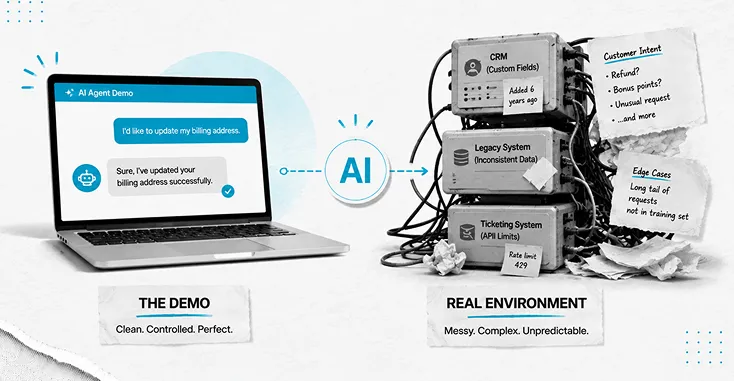
Why every agentic AI demo looks the same, and why that is the problem
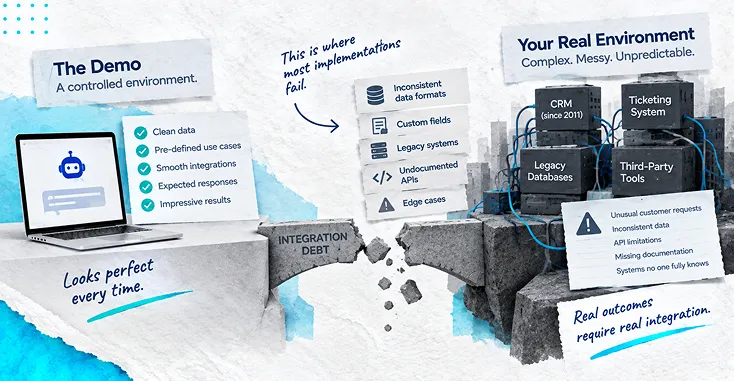
A demo environment is a controlled environment. The data is clean, the integrations are stubbed or purpose-built, the customer intents are the ones the vendor has already trained against, and the edge cases have been quietly removed from the script. Nothing about that is dishonest. It is simply what a demo is.
The problem is that your environment is the opposite of that. Your customer data lives across three systems with inconsistent formatting. Your CRM has custom fields that were added six years ago by someone who has since left. Your contact reasons include a long tail of genuinely unusual requests that do not appear in any vendor’s training set. Your ticketing system has an API with undocumented rate limits.
An agentic AI system that performs beautifully in a demo and badly in your environment has not malfunctioned. It has simply encountered the reality it was never tested against.
This is why the most valuable thing you can ask a vendor to do during evaluation is not a demo at all. It is a proof of concept against your data, in your environment, with your worst-case contact scenarios included deliberately.
Learn how PAteam deploys agentic AI in production environments.
The seven questions that separate a real agentic AI partner from a good demo
These are the questions that consistently expose capability gaps during evaluation. Ask them in this order.
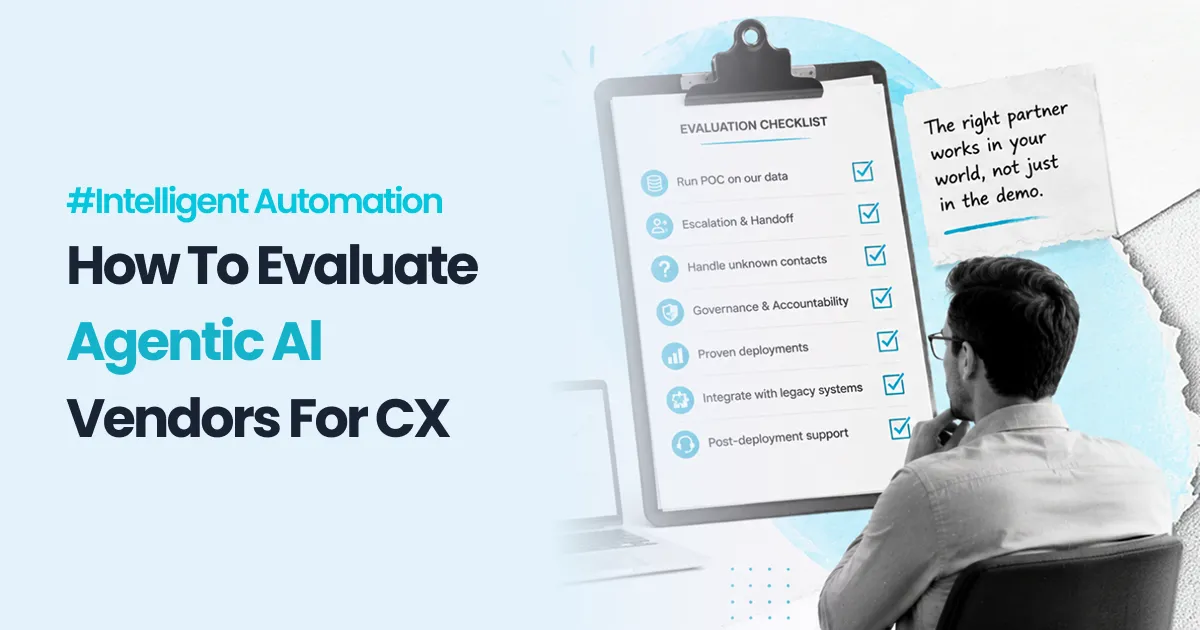
Can you run a proof of concept against our data, in our environment, on a use case we choose?
Not a sandbox. Not a curated dataset. If a vendor resists this or wants to select the use case themselves, that resistance is your answer.
What happens when the AI agent cannot resolve the contact?
Listen specifically for how escalation to a human is designed. The handoff is where customer experience actually breaks. A vendor who has thought hard about escalation has thought hard about production.
How does the system handle a contact type it has never seen before?
The long tail is where autonomous systems fail most visibly. A vendor who says the model "handles it" has not been in production long enough.
What is your governance model, and who is accountable when the agent gets something wrong?
This is the question most vendors are least prepared for. There must be a clear framework covering decision logging, human review thresholds, escalation authority, and remediation. If governance is a slide rather than a system, walk carefully.
Show me a client deployment you still operate today, with current volume numbers.
Launches are easy to point to. Sustained production volume is the actual proof. Ask for the numbers and ask how long the deployment has been running.
How do you integrate with legacy systems that have no modern API?
Every enterprise has at least one. The answer to this question tells you whether the vendor has done real enterprise work or only greenfield deployments.
What does your post-deployment support model look like?
Agentic AI systems drift. Customer behaviour changes, products change, policies change. If the vendor's engagement ends at go-live, you are accepting all of the ongoing accuracy risk yourself.
Why agentic AI implementations fail, and it is rarely the model
When an agentic AI deployment underperforms, the instinct is to question the model. Wrong provider, wrong architecture, not enough training data.
That is almost always the wrong diagnosis.
The failures we see in the field cluster around four causes, and none of them are the model itself.
Integration debt. The agent cannot reliably read or write to the systems it needs, so it either guesses or escalates everything. Containment rate stays flat and the business case collapses.
Unstructured knowledge. The agent is expected to answer from a knowledge base that is out of date, contradictory, or spread across a wiki, a shared drive, and the heads of three senior agents. The agent is only ever as accurate as the knowledge it can reach.
No governance framework. Nobody defined the thresholds at which a human must review a decision, nobody is auditing agent outputs, and nobody owns remediation. The first significant error becomes an executive incident rather than a logged exception.
Escalation designed as an afterthought. The agent handles the easy eighty percent well and hands off the hard twenty percent badly, so the customers with the most complex problems get the worst experience. Overall CSAT drops even though containment went up.
Think of it this way: deploying an agentic AI system without an integration and governance foundation is like hiring an extremely capable new employee, giving them no access to your systems, no accurate documentation, and no manager to escalate to. They will be confident, fast, and frequently wrong. The failure is not the hire. It is the environment.
What an agentic AI governance framework for enterprise actually needs to contain
Governance is the section most vendor proposals treat as a formality. It is the section that determines whether the deployment survives its first significant error.
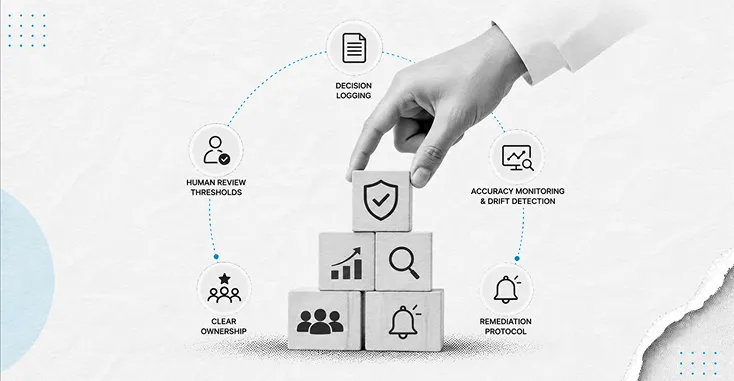
A real framework covers five things.
1
Decision logging.
Every autonomous action the agent takes must be recorded with enough context to reconstruct why it took that action. Without this, you cannot audit, cannot debug, and cannot defend the system in a compliance review.
2
Human review thresholds.
Specific, documented conditions under which the agent must hand off to a human rather than act. Financial value, customer tier, contact sensitivity, and confidence score are the common triggers. These must be set deliberately, not inherited from a default configuration.
3
Accuracy monitoring and drift detection.
Agent performance degrades over time as the underlying business changes. Someone must be measuring accuracy against a sampled baseline on an ongoing basis, with defined thresholds that trigger retraining.
4
Clear ownership.
A named individual on the client side who owns agent performance, and a defined escalation path into the implementation partner. Shared ownership means no ownership.
5
Remediation protocol
What happens in the first hour after a significant agent error is discovered. Who is notified, what gets paused, how the customer impact is assessed and addressed.
If your shortlisted vendor cannot walk you through all five, the governance work will fall to your team after go-live, at a point where you have the least context and the most pressure.
What good looks like, and how PAteam delivers it
Here is how we approach agentic AI in the enterprise, and why our deployments hold up in production.
PAteam runs every agentic AI engagement on a five-phase methodology: Discover, Design, Launch, Enable, Scale.
⇒ Discover. Two to four weeks understanding the contact landscape as it actually operates. Contact reasons by volume, the long tail of unusual requests, the state of the knowledge base, the reality of every integration point. We do this before designing anything, because designing an agent against an assumed contact profile is the most common source of downstream failure.
⇒ Design. We design the agent, the escalation model, and the governance framework in parallel. Not sequentially. The escalation path and the human review thresholds are designed with the same rigour as the resolution flow, because that is where the customer experience risk actually concentrates.
⇒ Launch. We deploy against a controlled contact segment first, measure accuracy and containment against a baseline, then expand. No enterprise-wide launch on day one.
⇒ Enable. We transfer ownership properly. The client team gets the monitoring tooling, the runbooks, the review protocol, and the training to own agent performance within ninety days.
⇒ Scale. Once accuracy is proven and governance is operating, we expand channels and contact types on a foundation that is already stable.
At Bridge Marketing, an e-commerce client, PAteam’s agentic AI deployment now resolves 20,000 monthly inquiries in under 60 seconds each. Across our CX engagements we consistently deliver containment rate improved by 10%, AHT reduced by 15%, cost-to-serve reduced by 15%, and ROI payback inside six months.
Those numbers exist because the integration and governance work happened first, not because the model was better than anyone else’s.
See how PAteam structures agentic AI delivery.
PAteam’s honest take: some CX use cases are not ready for agentic AI
This is the part a vendor closing a deal usually skips.
Not every contact type should be handed to an autonomous agent, and not every organisation is ready to deploy one.
If your knowledge base is out of date and nobody owns it, an agentic AI deployment will surface that problem at scale and in front of customers. The right sequence is knowledge remediation first, agent deployment second. That takes longer and it is not what most vendors will tell you during procurement.
If your contact profile is dominated by genuinely complex, high-judgment, emotionally sensitive interactions, the containment gains will be modest and the reputational risk of getting one wrong is high. Those environments are better served by agent assist than by autonomous resolution, at least initially.
And if your executive team is expecting agentic AI to reduce headcount in the first six months, the program is being sold on the wrong business case. The reliable early return is faster resolution, better containment on high-volume simple contacts, and human capacity redirected to complex work. Headcount conversations, if they happen at all, come much later.
We say this during Discover when it is true. It costs us deals occasionally. It also means the clients who proceed with us are proceeding on a business case that will actually hold.
Frequently Asked Questions
How long should an agentic AI vendor evaluation take?
For an enterprise CX deployment, budget six to ten weeks from shortlist to decision, including a live proof of concept against your own data. Anything faster means you are deciding on demos alone. PAteam runs evaluation POCs as a fixed-scope three-to-four-week engagement against a client-selected use case, with measured accuracy and containment results at the end. If a vendor cannot commit to that, the evaluation is incomplete.
What is a realistic containment rate to expect from agentic AI in CX?
It depends entirely on your contact mix. For high-volume, low-complexity inquiry types, strong deployments reach containment in the seventy to ninety percent range. Across a full mixed contact profile, a 10% improvement in overall containment rate in the first six months is a solid, defensible result and is what PAteam typically delivers. Any vendor promising a blanket containment figure before seeing your contact data is guessing.
What should we look for in an agentic AI implementation partner rather than a platform vendor?
The distinction matters. A platform vendor sells you the capability. An implementation partner is accountable for the outcome in your environment. Look specifically for integration experience with legacy systems, a documented governance framework, a post-deployment support model, and named client deployments still running today with current volume numbers. PAteam has been delivering in enterprise CX environments for nearly a decade, which is why our evaluation conversations start with your integrations, not our capabilities.
Who is accountable when an AI agent makes a costly mistake with a customer?
Contractually, this needs to be explicit before you sign, and most vendor contracts push the accountability entirely to the client. Operationally, the answer should be a documented remediation protocol with a named owner on both sides and defined human review thresholds that prevent high-value or high-sensitivity decisions from being made autonomously in the first place. If your vendor has not raised this during evaluation, raise it yourself and treat the quality of the answer as a primary selection criterion.
Can we deploy agentic AI on top of our existing legacy CRM, or do we need to replatform first?
In most cases, yes, you can deploy without replatforming. PAteam has integrated agentic AI into environments with CRMs well over a decade old, including systems with no modern API, using middleware and digital workers to bridge the gap. The honest caveat is that legacy integration adds four to eight weeks to the delivery timeline and the integration layer needs ongoing maintenance. Anyone who tells you legacy integration is trivial has not done it.

Three things to take from this post
The demo tells you almost nothing. The only evaluation step that reliably predicts production performance is a proof of concept against your own data, in your own environment, on a use case you choose, with your worst-case contacts included deliberately.
Agentic AI implementations fail on integration debt, unstructured knowledge, missing governance, and badly designed escalation. They very rarely fail on the model. Evaluate vendors on those four dimensions and the shortlist will separate quickly.
Governance is not paperwork. Decision logging, human review thresholds, drift monitoring, clear ownership, and a remediation protocol are what stand between a strong deployment and an executive incident.
If you are mid-evaluation right now and every vendor is starting to sound the same, the fastest way to break the tie is to test them against your environment.
Book a 30-minute working session with PAteam. We will map your highest-volume contact types, show you exactly where agentic AI will and will not deliver, and give you the evaluation criteria to hold every vendor to.