
A statement of work crossed our desk last year with a line in the scope section that read, in full: “Automate the contract intake process.” No volumes, no definition of intake, no statement of where the process started or stopped. It had been signed by both parties.
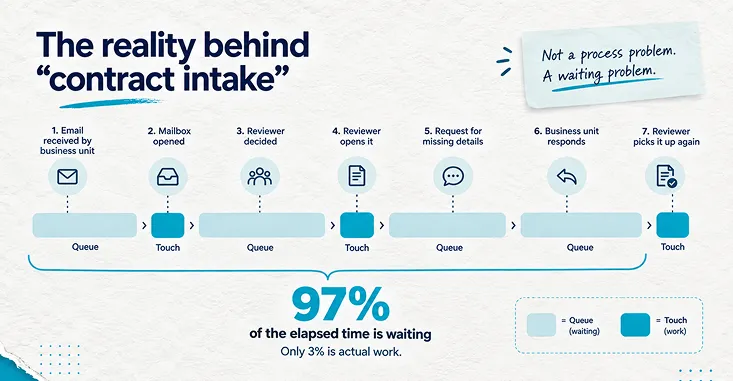
That line is not unusual, and it is not really about contracts. It is about a category error that runs through most legal automation projects. “Intake” in that firm turned out to be seven separate waits: a business unit emailing a shared mailbox, someone opening the mailbox, someone deciding which reviewer it belonged to, the reviewer opening it, the reviewer asking for the missing counterparty details, the business unit answering, and the reviewer picking it up again. Almost none of the elapsed time was work. Nearly all of it was waiting for the next person to look.
That distinction decides which legal workflows are worth automating first, and it is the organising idea of everything below.
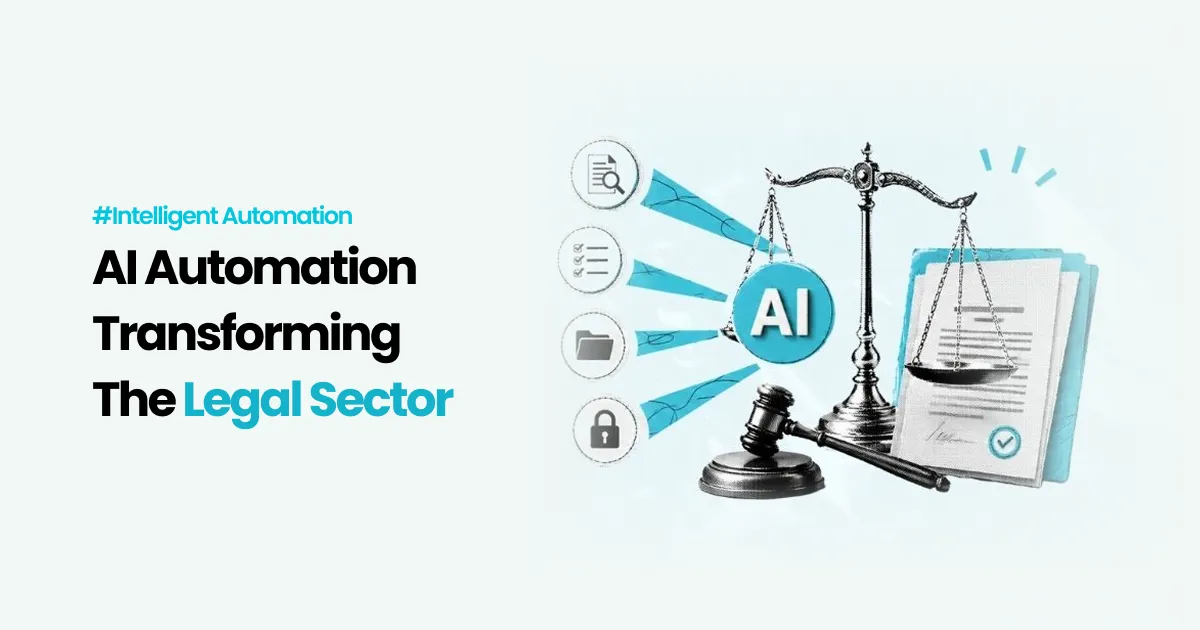
What intelligent automation means in legal work
Intelligent automation is the combination of three things that used to be bought separately. Rule-based automation, usually called RPA (robotic process automation), moves data between systems and performs deterministic steps. Document intelligence reads a file and extracts structured fields from it. A model, increasingly a generative one, drafts or classifies or summarises. Orchestration decides which of these runs, in what order, and when a human is required.
In legal work the useful framing is narrower than the vendor framing. Intelligent automation does not replace legal judgement, and any description of it that implies otherwise should be treated as a sales artefact. What it does is remove the steps between judgements: the routing, the chasing, the copying of the same eight fields into a third system, the assembling of the pack that a reviewer needs before the reviewer can think.
Two acronyms recur below and are worth fixing now. ESI means electronically stored information, the term the discovery process uses for anything that lives in a system rather than on paper. GAI means generative artificial intelligence, which is the term the American Bar Association uses in its ethics guidance, so it is the term used here when discussing that guidance.
Sort your use cases before you cost them
The six workflows legal teams usually shortlist are not one category. They divide cleanly by what is actually holding them up, and the division changes both the business case and the risk posture.
The practical consequence is uncomfortable for pilot selection. Judgement-bound work is more interesting, demos better, and is what most vendors lead with. Queue-bound work is where the first measurable win lives. A programme that starts with contract review because it is impressive, rather than with intake because it is slow, tends to produce a well-received demonstration and no defensible number.
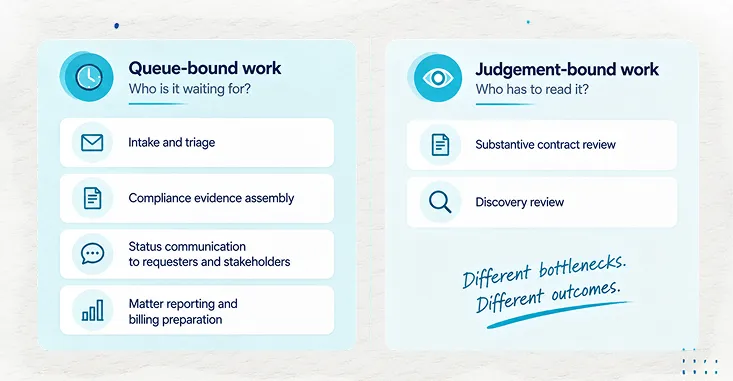
The four queue-bound candidates
That is not a pedantic correction. Automation designed around a linear pipeline breaks the first time a matter cycles back, and matters cycle back constantly. EDRM’s own definitions are worth keeping in front of the design: identification is “locating potential sources of ESI and determining its scope, breadth and depth”, preservation is “ensuring that ESI is protected against inappropriate alteration or destruction”, processing is “reducing the volume of ESI and converting it, if necessary, to forms more suitable for review and analysis”, and review is “evaluating ESI for relevance and privilege”. Three of those four are volume and custody problems. One of them is a judgement problem. Automate the three.
An illustrative model, in which touch time gets worse
The following model is illustrative. The structure and the arithmetic are real and reproducible; the inputs are stated assumptions rather than measurements from a specific engagement, and any team using it should replace every one of them with its own numbers before showing it to a finance function.
The workflow is one inbound agreement review request, of the NDA (non-disclosure agreement) and standard vendor paperwork type. The clock starts when the request arrives and stops when the agreement is returned or executed. A working day is eight hours.
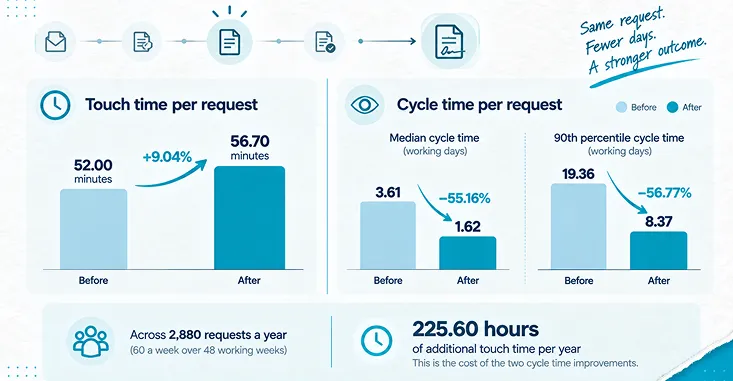
Before. Seven queued handoffs. Median wait per handoff of four hours, which is half a working day, so a request that arrives in the morning is looked at in the afternoon. Ninety-fifth-percentile behaviour is not the interesting tail here; the ninetieth is, and at the ninetieth percentile the wait per handoff is 22 hours, or nearly three working days, because the reviewer is in a hearing or the requester is on leave. Human touch time across the whole request is 52 minutes.
That gives a median cycle time of 3.61 working days and a ninetieth-percentile cycle time of 19.36 working days. The queue accounts for 97.00 percent of the median. Fifty-two minutes of work is spread across three and a half days, and across nineteen days for one request in ten.
After. Intake, triage, routing and chasing are automated, which takes the queued handoffs from seven to three. Touch time does not fall to zero, and this is the part most business cases get wrong. It rises. The reviewer now confirms extracted terms instead of assembling them, which is 45 minutes rather than 52. Then a verification pass runs on every single request, without exception, at nine minutes. Then 18 percent of requests are routed to a closer second read at a further 15 minutes. Total touch time after automation is 56.70 minutes.
So the headline numbers move in opposite directions, and both belong on the same slide:
- Touch time per request: 52.00 minutes to 56.70 minutes, an increase of 4.70 minutes, or 9.04 percent.
- Median cycle time: 3.61 working days to 1.62 working days, a reduction of 1.99 days, or 55.16 percent.
- Ninetieth-percentile cycle time: 19.36 working days to 8.37 working days, a reduction of 10.99 days, or 56.77 percent.
- The gap between the median and the ninetieth percentile: 15.75 working days to 6.75 working days.
- Queue share of the median: 97.00 percent to 92.70 percent.
Across 2,880 requests a year (60 a week over 48 working weeks) the added touch time totals 225.60 hours. That is the honest bill. It buys back two working days on the median request and eleven on the difficult one, and it makes the difficult one less than half as far from the typical one, which is usually what a general counsel is actually being asked about.
Presenting it the other way round, as a reduction in effort, is the version that fails under examination. Anyone who then measures reviewer hours will find them up, conclude the programme was oversold, and be right.
The three breakevens that decide whether it holds
A model without its breakevens tells leadership what to hope for. Put the breakevens next to it and it tells them what has to be true.
Breakeven one: the queue has to be genuinely slow.
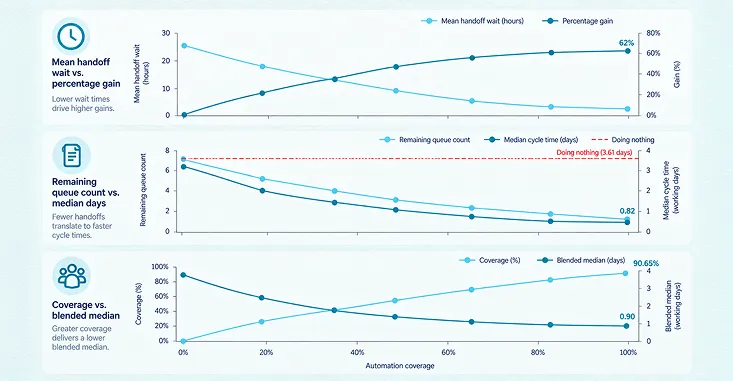
The whole gain comes from removing four waits, and it is paid for with 4.70 extra minutes of touch time. Those cancel out when the mean wait per handoff falls to 1.175 minutes. Above that, removing handoffs wins; below it, the extra verification effort buys nothing. That threshold is so low that it makes a useful point in the negative direction: in almost any legal function with a shared inbox, this trade is worth making. But run the sensitivity and the picture at the fast end changes character. At a mean wait of 240 minutes the median improves by 55.2 percent. At 120 minutes, 53.3 percent. At 60 minutes, 49.9 percent. At 20 minutes, 39.2 percent, and the absolute saving has collapsed to 0.16 of a working day. A team whose requests are already picked up within twenty minutes should automate something else.
Breakeven two: the removed steps must not come back as new steps.
Parity with the original 3.61-day median sits at 6.980 remaining handoffs. Start from the post-automation three and add queued review steps: one more takes the median to 2.12 days, two to 2.62, three to 3.12, and four to 3.62 days, which is worse than doing nothing. This is the most common way a technically successful legal automation produces no improvement anyone can feel. Verification becomes a queue. Exception handling becomes a queue. Approval of the automated output becomes a queue. Each is defensible on its own and four of them return the entire gain. Any design review should count the queues in the target state out loud, not the steps.
Breakeven three: coverage, not released hours.
There are no released hours here to realise, because touch time went up. What has to be realised is coverage: the share of requests that actually travel the shortened path rather than being pulled out of it because the counterparty sent a Word document with tracked changes, or because the requester emailed the reviewer directly. At 90 percent coverage the blended median is 1.82 days. At 75 percent, 2.12 days. At 60 percent, 2.41 days. At 40 percent, 2.81 days, and a 55 percent improvement has become 22 percent. To halve the median, coverage has to reach 90.65 percent. That number should be in the scope document, and the workflows that bypass the path should be named before go-live rather than discovered afterwards.
What safe adoption requires, specifically
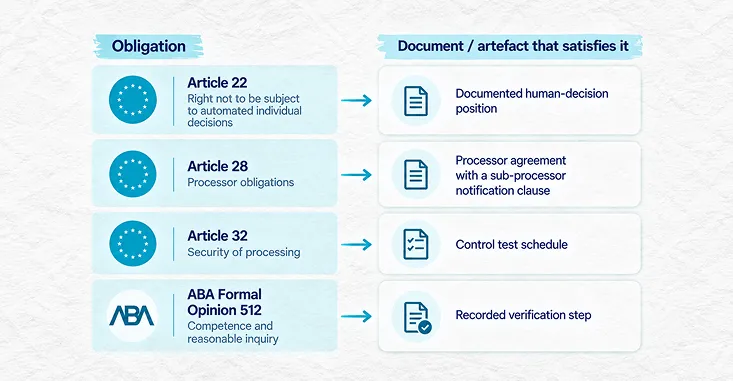
Safe adoption in legal work is not a disposition, it is a set of documented positions. Four of them are load-bearing.
The passage worth reading twice is the one on fees, because it is the closest thing to an authoritative ruling on the model above. The fifteen-page opinion notes, per the ABA’s release, that where a lawyer uses a GAI tool to draft a pleading and spends 15 minutes inputting the relevant information, “the lawyer may charge for that time as well as for the time necessary to review the resulting draft for accuracy and completeness. But, in most circumstances, the lawyer cannot charge a client for learning how to work a GAI tool.”
Read that against the model. The 561.60 hours a year of verification effort is review of output for accuracy and completeness, which the opinion treats as chargeable. The ramp-up, three fee-earners spending six hours each learning the tool, is 18 hours that generally cannot be billed to anyone. That is a ratio of 31.2 to 1 in favour of the chargeable side, which is a comfortable position, and it is only comfortable because verification was designed as a reviewable step on every request rather than as an informal habit. A verification pass that is not recorded is not obviously billable and not obviously happening. This is one place where the ethics requirement and the operational requirement point at exactly the same control.
The regulatory reasoning on why supervision itself gets harder is worth quoting rather than paraphrasing. The Solicitors Regulation Authority’s Risk Outlook report on artificial intelligence in the legal market, published 20 November 2023, puts it this way: “The speed that makes AI so useful can also make problems worse. Errors by an AI system could affect many more people than errors by a single person could… The high output of an AI system also makes it harder to supervise effectively.” It also names the confidentiality failure mode precisely, as “the output from an AI system replicating confidential details from one case in its response to another”, and forecloses the delegation argument: “you will remain responsible and accountable for the outputs from AI you are using. For example, if you use a third party chatbot to provide initial legal advice, you remain responsible for any errors in that advice.”
The report is now some years old and its adoption statistics are dated and, in its own words, reported secondhand, so it should not be cited as a picture of the current market. Cited for what it is, a regulator on the record about supervision and accountability, it has not aged at all.
The failure mode nobody instruments
Here is the mechanism that does the most damage, and it is not hallucination.
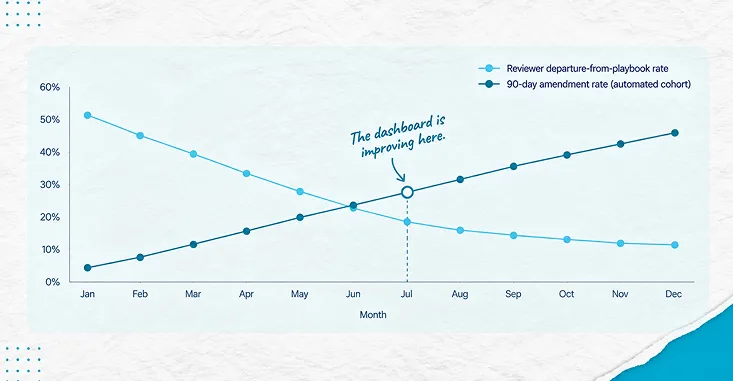
When a system extracts terms and compares them against a playbook, the reviewer’s job changes from constructing a position to agreeing or disagreeing with one. Agreeing is faster than disagreeing, because disagreeing means writing the alternative. Over a few months, the rate at which reviewers depart from the suggested position drifts down. Cycle time improves. Throughput improves. Every number on the dashboard improves. What has actually happened is that the playbook position is now being accepted in situations it was not written for, and the cost surfaces somewhere the automation programme is not measured: in amendments, in escalations during performance, in the commercial team relitigating a term nine months later.
How to detect it. Sample agreements that were executed through the automated path and check what proportion were amended, side-lettered or renegotiated within 90 days of signature, then compare that proportion against agreements executed before the change. If the automated cohort is amended more often, the improvement in cycle time is partly a transfer of work into the future rather than a removal of it. Track the reviewer departure rate from the suggested position as a series in its own right, and treat a falling series as a signal to investigate rather than as good news. A departure rate trending to zero means the reviewer has stopped being a reviewer.
The second detection method is cheaper and specific to generative output. Verify citations mechanically, not attentively. The AI Hallucination Cases database maintained by Damien Charlotin, updated 11 August 2026, records 1,870 identified cases in which a court or tribunal explicitly found or implied that a party relied on hallucinated content, with 1,558 involving fabricated material and 1,680 concerning case law. Two things about that dataset deserve stating rather than glossing. First, its own scope note: it tracks only decisions where the court made that finding, and “does not track the (necessarily wider) universe of all fake citations or use of AI in court filings”, and it describes itself as “a work in progress” while seeking to be exhaustive. So it is a floor, not a count.
Second, the party breakdown inverts the story the professional press usually tells. Pro se litigants account for 1,097 of the entries and lawyers for 725, with 27 involving judges. The dominant risk is therefore not principally that your own lawyers file a fabricated citation; it is that fabricated material is arriving at your organisation from the other side of a matter, from unrepresented counterparties, from claimants, and increasingly from opposing filings. An automation programme designed only to police its own output has covered the smaller half of the problem. The higher-value control is verifying inbound citations too, which is a mechanical lookup, which is to say it is exactly the kind of work that automates well.
The SRA report explains the mechanism in a sentence that is worth keeping in the design document, because it rules out the tempting shortcut: language models “work by anticipating the text that should follow the input they are given, but do not have a concept of ‘reality'”. The report’s own instruction follows from that, and it is unambiguous: “do not trust an AI system to judge its own accuracy”.
What it looks like when the ground moves
A global logistics operator running a European shared-services function came to us with a document-heavy workflow scoped, costed and agreed. Partway through delivery the upstream system it depended on changed: different fields, different structure, different behaviour on the exception path. The original design was, at that point, a correct solution to a problem that no longer existed.
What mattered was not the original architecture. It was that the workflow had been built so that the extraction layer, the routing rules and the exception handling could be changed independently, and that the exception path had been specified as a real destination with a named owner rather than as an error state. Re-pointing the extraction and adjusting the routing was a contained piece of work. Had the logic been a single monolithic sequence with exceptions treated as failures, it would have been a rebuild.
The reason this belongs in a legal article is that legal document workflows change underneath you more often than most. Playbook positions get revised. Templates get replaced. A new regulation adds a mandatory clause. A counterparty’s standard form changes. If the design assumes stability, every one of those events is a project. The question to ask of a proposed legal automation is not whether it handles today’s template, but what specifically has to be touched when the template changes, and who is able to touch it.
The renewal conversation
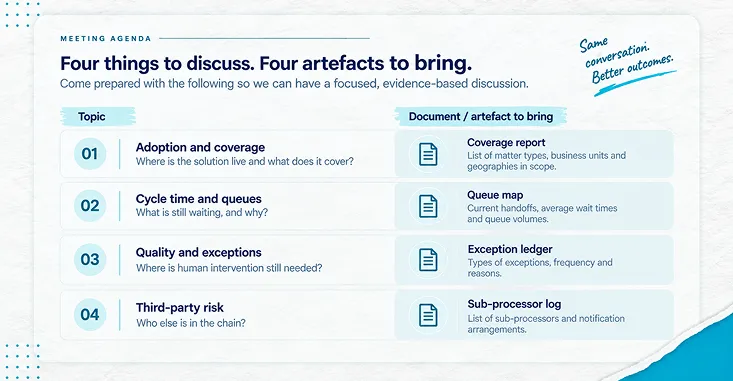
Most procurement advice concerns the questions to ask before signing, which is the conversation where a vendor is most prepared and you know least. The more informative conversation is the renewal, because by then you have a year of evidence and the vendor has a commercial reason to engage with it. Four things should be on that agenda, and agreeing them at the outset is what makes the renewal conversation possible at all.
A first workflow, chosen properly
Pick something that is high volume, low variation, queue-bound, and owned by a single team that can change how it works. Then instrument it for two weeks before touching anything, capturing four figures: the number of handoffs, the median wait at each one, the actual touch time, and the share of requests that bypass the standard path. Those four figures are the model. Without them, any business case is a set of assumptions wearing a spreadsheet.
Then build in the sequence that keeps the risk in front of you. Automate the intake and the routing first, because they contain no judgement and remove the most waiting. Add extraction next, with the verification step designed as a recorded action on every request rather than a habit. Define the exception path as a destination with an owner, not as a failure. Only then consider anything that touches judgement, and when you do, write down the Article 22 position and the client-communication position before the pilot rather than after it.
Where PAteam is usually useful is in the second half of that list rather than the first usually useful is in the second half of that list. Building an intake automation is not difficult. Building one that survives a template change, produces a coverage figure a finance function will accept, and leaves an audit trail that satisfies Article 30 is a different exercise, and it is mostly a question of how the exception path and the verification step were designed on day one. We work across intelligent automation, agentic workflows and contact-centre platforms agentic workflows, and in legal environments the pattern is consistent: the technology question is smaller than the design question, and the design question is smaller than the measurement question.