
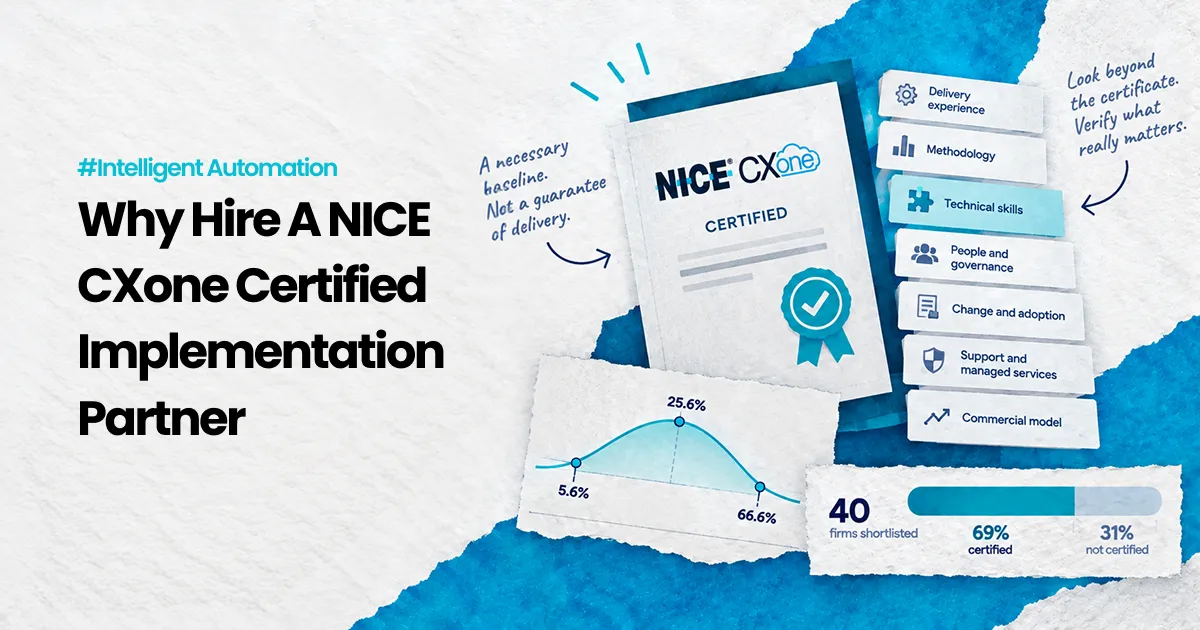
Here is a claim about PAteam that is completely true and almost completely useless: our engineers hold NICE CXone certifications.
It is true. It is checkable. And on its own it tells you nothing about whether your programme will land, because it is a statement about people passing exams, not about programmes reaching production. Every serious partner you shortlist will make the same claim. If a fact is shared by everyone on your list, it cannot help you choose between them.
That is not an argument against certification. It is an argument about what certification is for. A credential is a floor — it removes the firms that cannot clear a minimum. What it does not do is predict outcomes, and the interesting question is what you should verify instead, and what that verification is worth.
What a certification formally attests to
Take the general case first, because the standards world has already thought about this carefully.
ISO publishes a plain-language guide to ISO 9001, and it is unusually direct about scope. ISO’s own guide states that “ISO does not certify organizations” — certification is performed by independent certification bodies, and what those bodies audit is “the organization’s management system against ISO 9001:2015.” The guide also notes that certification is voluntary and is pursued when an organisation needs “an independent confirmation that they meet the requirements of ISO 9001:2015,” commonly in supplier approval processes and government tenders.
Read that carefully. The audit is of a management system against a set of requirements. It is not an audit of any deliverable, any programme, or any customer’s outcome. A certified quality management system is evidence that the firm has documented processes and reviews them. It is not evidence that your migration will hit its date.
Platform certification works the same way one level down. It attests that named individuals demonstrated defined competencies against a defined syllabus at a point in time. That is worth having — you do not want people learning the platform on your programme — but the object being certified is a person’s knowledge, not a programme’s trajectory.
So the honest formulation is: certification tells you a firm has cleared a floor. Verifying delivery tells you where above that floor it sits. Those are two different tests, and only one of them is expensive.
The regulation that refuses to let a credential stand in for a record
Public procurement has to make this judgement thousands of times a year with money that gets audited, so it is worth seeing how it is actually written down.
Under the US Federal Acquisition Regulation, before a contract is awarded the contracting officer must make an affirmative determination of responsibility. FAR 9.104-1 sets out seven general standards a prospective contractor must meet. Two of them matter here.
The first is the performance record. FAR 9.104-1(c) requires that a contractor “have a satisfactory performance record” — and then adds a sentence that is easy to skim past: “A prospective contractor shall not be determined responsible or nonresponsible solely on the basis of a lack of relevant performance history, except as provided in 9.104-2.” The regulation will neither convict nor acquit on history alone. History is necessary and insufficient, both at once.
The second is capability. FAR 9.104-1(e) requires the contractor to “have the necessary organization, experience, accounting and operational controls, and technical skills, or the ability to obtain them (including, as appropriate, such elements as production control procedures, property control systems, quality assurance measures, and safety programs …).”
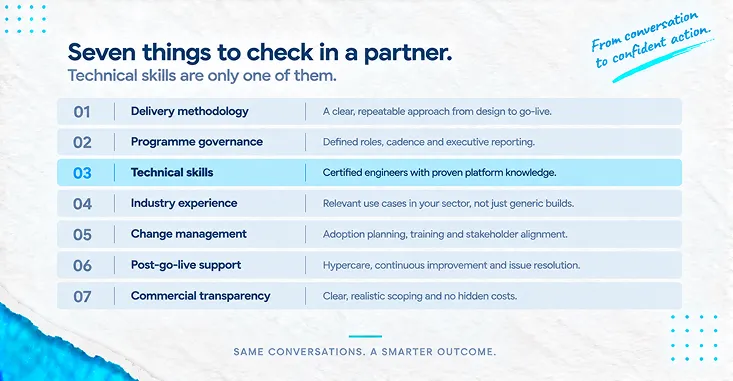
Notice what that clause is doing. Technical skills sit in a list alongside organisation, operational controls and quality assurance measures — and the clause explicitly permits “the ability to obtain them.” The skill is one item among several, and it does not even have to be resident today. A framework designed by people who award contracts for a living treats demonstrated technical competence as one of seven tests, not as the test.
If the regulation that governs hundreds of billions in awards will not let a credential carry a responsibility determination, your CXone shortlist should not let it either.
Why the performance record is the hard part
The obvious response is: fine, check the record instead. That is the right answer and it is harder than it sounds, because performance records are systematically incomplete even in systems built and mandated to hold them.
The US federal government runs a database for exactly this purpose. The Federal Awardee Performance and Integrity Information System is, in GAO’s description, “a database that provides a ‘report card’ on prospective contractors,” holding records such as whether a contract was terminated due to the fault of the contractor. Reporting into it is required by federal regulation, and reviewing it is required before awards above a dollar threshold.
GAO reported in September 2024 that federal agencies entered 2,384 integrity records covering fiscal years 2019 through 2023, of which ninety percent were contract terminations. It then found the gaps: across that five-year period, “335 contract terminations and 52 administrative agreements were reported in other sources but not in FAPIIS.” At the Department of Defense, GAO found the department “had limited insight into why 166 records were not reported.” The General Services Administration cited gaps in its own guidance and limited awareness of the requirement among its personnel. For scale, GAO notes the federal government awarded contracts to about 109,000 contractors with roughly $760 billion in obligations in fiscal 2023.
Sit with what that means for a buyer. A mandatory, regulated, centrally reviewed performance database is missing hundreds of terminations, and the agency responsible for the largest share of them cannot fully explain why. If that is what happens where reporting is a legal requirement, consider what the equivalent record looks like in commercial software delivery, where nobody is required to report anything and the only performance history you will see is the history your prospective partner chooses to show you.
This is the actual asymmetry in vendor selection. It is not that buyers cannot tell good partners from poor ones in principle. It is that the evidence which would let them is not collected by anyone with an interest in collecting it.
What happens to the evidence when nobody is required to keep it
The European Court of Auditors examined this from the buyer’s side, and the findings translate directly.
Its Special Report 17/2022 on external consultants at the European Commission reviewed procurement worth around €3.7 billion between 2017 and 2020, close to €1 billion a year. The auditors concluded that “the Commission’s management of the use of external consultants does not fully ensure that it maximises value for money.”
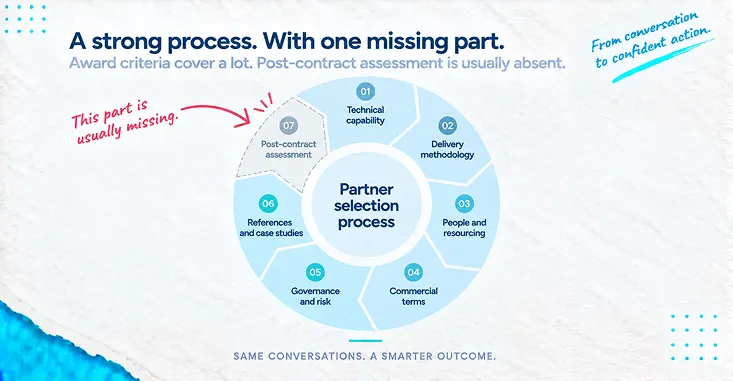
The part worth dwelling on is that the front of the process was fine. At paragraph 35, the report records that “in all 20 procurement procedures reviewed, the Commission used appropriate award criteria (including a price/quality ratio).” Twenty for twenty on award criteria. The problems were all downstream.
At paragraph 63: “directorates-general did not assess performance consistently. We found that only some directorates-general systematically performed lessons learnt exercises or ex-post cost benefit evaluation when contracts were completed, while others did not.” The auditors then name the consequence: “It also increases the risk of re-engaging consultants who have performed poorly in the past.”
And the finding that should change how you write your next statement of work, at paragraph 68: “The Commission confirmed that service contracts rarely consider the transfer of knowledge from consultants. It does not systematically consider whether a transfer of skills is needed. None of the contracts we reviewed included a specific requirement for skills transfer from the consultants to the Commission staff.”
None of them. Not a minority — none.
The report also shows what accumulates when performance is not assessed: at DG ESTAT, ten suppliers made up under 19% of the supplier count but took 87% of the contracted amount, €47 million; at DG NEAR the top ten were under 3% of suppliers but 41% of value, €277 million. At paragraph 44 the auditors found “four cases where, even though open tender procedures were organised regularly, the same suppliers won successive contracts over several years.”
That is a rigorous selection process producing incumbency rather than performance, because the loop that would have fed outcomes back into the next decision was never closed. A certification requirement at the front of the process cannot fix that. Only assessing what actually happened can.
What verification is actually worth
If certification is a floor and the record is hard to get, the practical question becomes whether it is worth spending money to get it. That is arithmetic, so here is the arithmetic.
The figures below are illustrative — chosen to be plausible for a mid-sized CXone programme, not measured from PAteam’s book. The purpose is to show which quantity the decision actually turns on, so you can substitute your own numbers and see where you land.
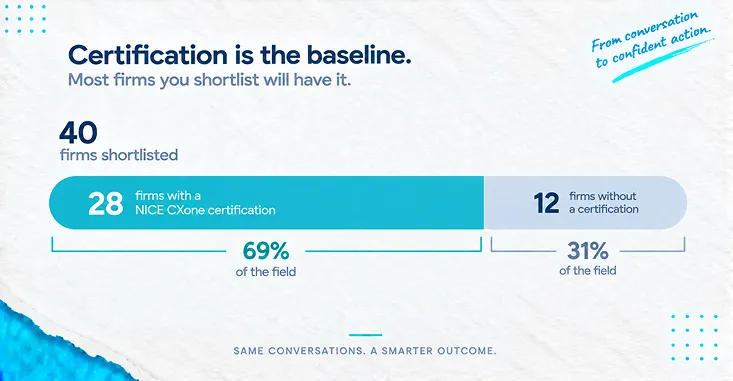
Suppose forty firms could plausibly bid. Suppose three in ten of them would deliver your programme substantially to plan; the other seven in ten would not. Now bring in the credential. Nine in ten of the good firms hold it. And — this is the number nobody states out loud — six in ten of the poor firms hold it too, because passing an exam is not the thing they are bad at.
Walk forty firms through that filter:
- Twelve would deliver to plan; twenty-eight would not.
- Of the twelve, 10.8 hold the certification. Of the twenty-eight, 16.8 hold it.
- So 27.6 of your forty are certified — 69% of the field.
- Among those 27.6, the ones who would deliver number 10.8. That is 39.1%.
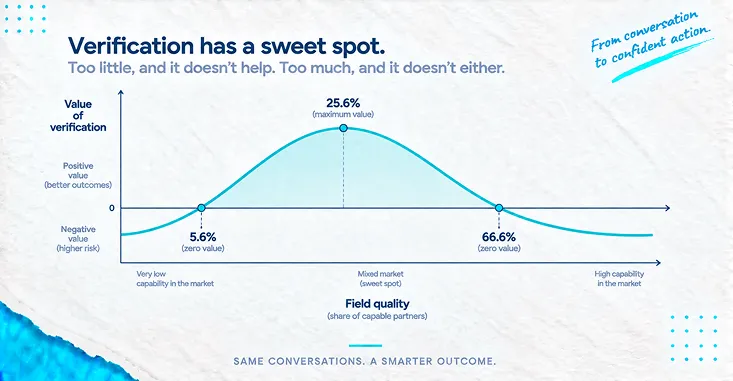
You started believing 30% of the field would deliver. After filtering on the credential you believe 39.1% will. The certification moved you nine percentage points. It is real information, and it is thin information, and the reason is visible in the ratio: 0.9 divided by 0.6 is 1.5. The credential is 1.5 times more likely to be present in a good firm than a poor one. A test with a likelihood ratio of 1.5 does not sort a field.
Now add a second filter: an actual check of delivery history. Not a reference call arranged by the vendor, but a specific verification — named programmes, named dates, the variance between planned and actual go-live, and the ability to speak to someone who ran the operation afterwards. Suppose that check clears three in four good firms and only one in five poor ones. Its likelihood ratio is 0.75 over 0.2, which is 3.75 — two and a half times as informative as the credential.
Apply it to the 27.6 certified firms:
- Of the 10.8 good ones, 8.1 survive.
- Of the 16.8 poor ones, 3.36 survive.
- Your shortlist is now 11.46 firms, and 8.1 of them would deliver. That is 70.7%.
The credential took you from 30% to 39.1%. The record check took you from 39.1% to 70.7% — a gain of 31.6 percentage points against the credential’s nine. The verification removed 80% of the poor firms that the certification had waved through, at the cost of losing 25% of the good ones, which is the honest price of any real test.
Price it. Say a programme that goes wrong costs you €480,000 in rework, delay and reset. Say the verification takes €26,000 of your people’s time and adds one month to selection at €55,000 of deferred benefit, so €81,000 all in.
- Certification only: 60.9% chance of a bad partner, so €292,174 of expected loss.
- Certification plus record check: 29.3% chance, so €140,733 of expected loss, plus €81,000 spent, giving €221,733.
- The verification is worth €70,441.
You can spend up to €151,441 on that verification before it stops paying for itself — 1.87 times what it actually costs. That is the headroom, and it is why “we did not have time to check properly” is almost never a real constraint.
The three numbers that decide it, and the case where verifying is a waste
Every model like this has conditions under which it is wrong. Here are this one’s, which are more interesting than the result.
Notice what is absent from all three conditions: how many certified engineers anyone has. It does not appear, because once every shortlisted firm holds the credential, the credential has no variance left to explain anything with.
The clause that decides whether a certified partner behaves like one
Selection is one half. The other half is what your contract does the first time the work turns out to be different from the work you scoped — because that moment arrives on every implementation, and it is where the money actually moves.
Public procurement has a rule for it. FAR 43.102 governs contract modifications, and subsection (b) states that modifications “shall be priced before their execution if this can be done without adversely affecting the interest of the Government. If a significant cost increase could result from a contract modification and time does not permit negotiation of a price, at least a ceiling price shall be negotiated unless impractical.”
Priced before execution. Or failing that, a ceiling before execution. Never work first and price later.
Subsection (a) closes the other door. Only the contracting officer may execute modifications, and other personnel must not “direct or encourage the contractor to perform work that should be the subject of a contract modification.” That sentence exists because the most common way scope grows is not a signed change order. It is an engineer on a call agreeing that something sounds sensible, work starting, and the invoice arriving three weeks later with nobody able to say who authorised it.
So write the first change request into the contract before you sign, with four things fixed: