
How to Evaluate Agentic AI Vendors for CX (Beyond the Demo)
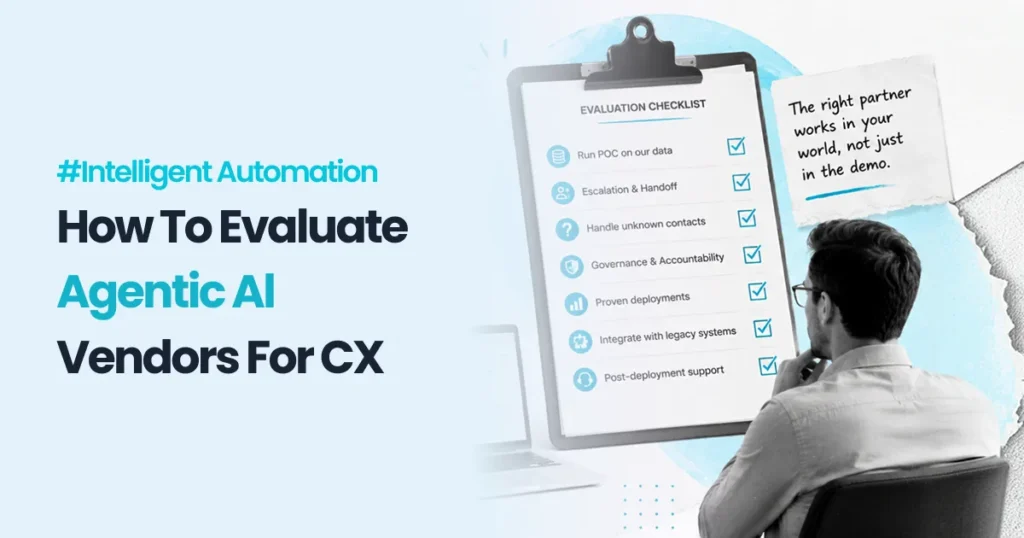
Four vendors on the shortlist. Four demos in eight days. Every one of them impressive, articulate, and apparently capable of resolving a customer inquiry end to end without human involvement. The CIO closes the laptop after the last session and realises they have learned almost nothing that distinguishes one from another. What they actually need to know is which of these four will still be working in March, once it has met the CRM that has been running since 2011 and the ticketing system nobody has fully documented. That gap between the demo and day one is where agentic AI programs are won or lost. Knowing how to evaluate agentic AI vendors for CX is now one of the highest-stakes procurement decisions in the enterprise, and the evaluation criteria most organisations use are borrowed from a software buying process that does not apply. You are not buying a product. You are buying a system that will make autonomous decisions on your behalf, in your environment, against your data. Here is what we actually think, based on delivering agentic AI in production: most agentic AI vendors will show you a demo that works perfectly in a clean environment. The only question that matters is what happens when it meets your actual systems on day one. Everything else in the evaluation is secondary to that. This post gives you the questions that expose the difference. Why every agentic AI demo looks the same, and why that is the problem A demo environment is a controlled environment. The data is clean, the integrations are stubbed or purpose-built, the customer intents are the ones the vendor has already trained against, and the edge cases have been quietly removed from the script. Nothing about that is dishonest. It is simply what a demo is. The problem is that your environment is the opposite of that. Your customer data lives across three systems with inconsistent formatting. Your CRM has custom fields that were added six years ago by someone who has since left. Your contact reasons include a long tail of genuinely unusual requests that do not appear in any vendor’s training set. Your ticketing system has an API with undocumented rate limits. An agentic AI system that performs beautifully in a demo and badly in your environment has not malfunctioned. It has simply encountered the reality it was never tested against. This is why the most valuable thing you can ask a vendor to do during evaluation is not a demo at all. It is a proof of concept against your data, in your environment, with your worst-case contact scenarios included deliberately. Learn how PAteam deploys agentic AI in production environments. The seven questions that separate a real agentic AI partner from a good demo These are the questions that consistently expose capability gaps during evaluation. Ask them in this order. Can you run a proof of concept against our data, in our environment, on a use case we choose? Not a sandbox. Not a curated dataset. If a vendor resists this or wants to select the use case themselves, that resistance is your answer. What happens when the AI agent cannot resolve the contact? Listen specifically for how escalation to a human is designed. The handoff is where customer experience actually breaks. A vendor who has thought hard about escalation has thought hard about production. How does the system handle a contact type it has never seen before? The long tail is where autonomous systems fail most visibly. A vendor who says the model “handles it” has not been in production long enough. What is your governance model, and who is accountable when the agent gets something wrong? This is the question most vendors are least prepared for. There must be a clear framework covering decision logging, human review thresholds, escalation authority, and remediation. If governance is a slide rather than a system, walk carefully. Show me a client deployment you still operate today, with current volume numbers. Launches are easy to point to. Sustained production volume is the actual proof. Ask for the numbers and ask how long the deployment has been running. How do you integrate with legacy systems that have no modern API? Every enterprise has at least one. The answer to this question tells you whether the vendor has done real enterprise work or only greenfield deployments. What does your post-deployment support model look like? Agentic AI systems drift. Customer behaviour changes, products change, policies change. If the vendor’s engagement ends at go-live, you are accepting all of the ongoing accuracy risk yourself. Why agentic AI implementations fail, and it is rarely the model When an agentic AI deployment underperforms, the instinct is to question the model. Wrong provider, wrong architecture, not enough training data. That is almost always the wrong diagnosis. The failures we see in the field cluster around four causes, and none of them are the model itself. Integration debt. The agent cannot reliably read or write to the systems it needs, so it either guesses or escalates everything. Containment rate stays flat and the business case collapses. Unstructured knowledge. The agent is expected to answer from a knowledge base that is out of date, contradictory, or spread across a wiki, a shared drive, and the heads of three senior agents. The agent is only ever as accurate as the knowledge it can reach. No governance framework. Nobody defined the thresholds at which a human must review a decision, nobody is auditing agent outputs, and nobody owns remediation. The first significant error becomes an executive incident rather than a logged exception. Escalation designed as an afterthought. The agent handles the easy eighty percent well and hands off the hard twenty percent badly, so the customers with the most complex problems get the worst experience. Overall CSAT drops even though containment went up. Think of it this way: deploying an agentic AI system without an integration and governance foundation is like hiring an extremely capable new employee,