
For the person applying, a disability decision is rent, heating, medication, and stability. For the firm representing them, it is a file that has to be moved through a federal process that does not reward speed and does not pay for effort. Those two facts sit on top of each other, and the second one is where the operational problem lives.
The economics are fixed at the top
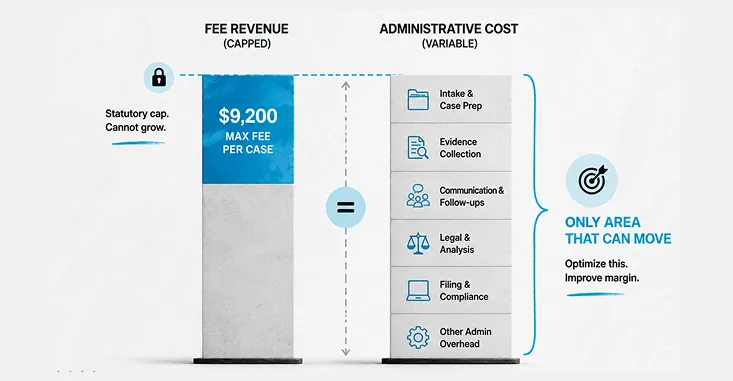
A representative’s fee in an SSD case is set by statute, not by the market. Under $404.1730 of SSA’s regulations, where SSA makes a favourable determination and past-due benefits result, it pays the representative the smaller of twenty-five percent of total past-due benefits or the fee it sets, less an assessment capped at 6.3 percent. The dollar ceiling on that calculation rose to $9,200 effective 30 November 2024, announced in SSA’s Federal Register notice of 10 May 2024.
There is a detail here that most commentary has not caught up with. That 2024 notice also committed SSA to publishing an annual notice from January 2026 explaining whether it was raising the cap or holding it. SSA rescinded that commitment in a partial rescission published 6 May 2025, retaining the $9,200 figure but stating it will now publish only when it increases the cap, on the grounds that an annual notice regardless of outcome imposes administrative burden the Act does not require.
Read that as an operator rather than a lawyer. The ceiling is fixed, the twenty-five percent rule means the cap binds only once past-due benefits reach $36,800, and there is no longer a scheduled annual signal that the ceiling might move. A firm planning capacity cannot assume the revenue line rises on a timetable. It rises when caseload rises, which means the only reliable lever on margin is cost per case.
That is the whole reason automation belongs in this conversation, and it is a narrower reason than most vendors offer. This is not about doing law better. It is about the administrative work stacked around the law, which the fee schedule never priced separately and which grows in direct proportion to volume.
The wait is getting longer, and not smoothly
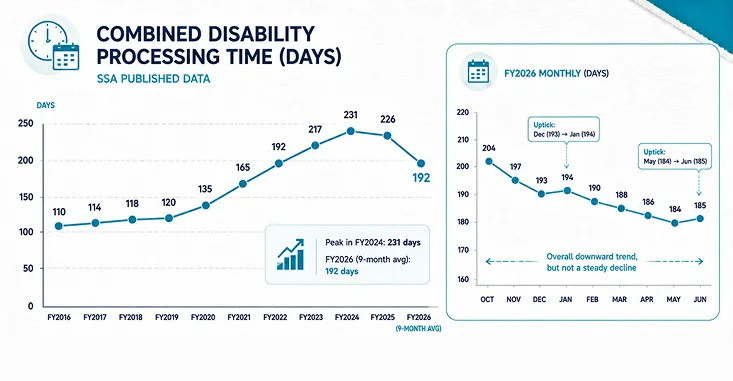
SSA publishes combined disability processing time by fiscal year, and the trend is unambiguous. Its combined disability processing time series records 110 days in FY2016, rising to 120 by FY2019, then 165 in FY2021, 217 in FY2023, and a peak of 231 in FY2024. FY2025 came in at 226. The first nine months of FY2026 average 192.
The honest reading of the recent monthly data is more interesting than the one usually offered. Within FY2026 the monthly figures move from 204 in October down to 184 by May, then back up to 185 in June. December to January also rose, from 193 to 194. The direction over the year is downward, but it is not a steady decline, and anyone describing it as one has not opened the monthly file. That distinction matters operationally: a firm sizing its pipeline against a smooth improvement curve will get its staffing wrong in the months where the line turns.
One caveat belongs in the reading rather than in a footnote. SSA’s own denominator language defines this as processing time for cases with a decision in the period, which means it describes cases that finished, not cases still waiting. Improvement in the series is consistent with faster closure of a favourable mix as well as with genuine throughput gains.
Where the administrative load actually sits
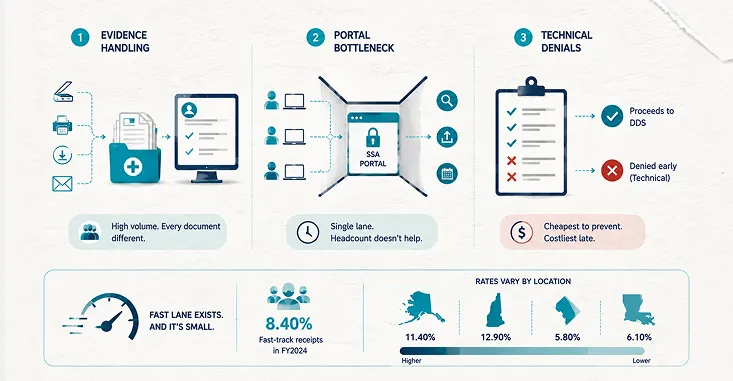
Three places, and they are not the ones a partner usually names first.
There is also a fast lane, and it is smaller than firms assume. SSA’s Quick Disability Determination model flags cases likely to be allowed on medical evidence alone, and its fast-track receipts data shows 180,116 of 2,155,574 national DDS electronic receipts in FY2024 were fast-tracked, which is 8.40 percent. That is up from 4.20 percent in FY2010, so the mechanism is real and growing. It is also unevenly distributed: 5.80 percent in the District of Columbia and 6.10 percent in Louisiana against 11.40 percent in Alaska and 12.90 percent in New Hampshire. A firm with a national caseload cannot plan on a single fast-lane rate, because its effective rate is a function of where its claimants live.
Why scripted automation keeps failing here
Most firms that have tried automation have tried rules-based robotic process automation, and most have been disappointed. The reason is structural rather than a matter of poor implementation.
Scripted automation assumes that the thing arriving looks the way it looked last time. It works from screen positions, field labels, and fixed document layouts. SSD document flow violates that assumption constantly, because the format is set by whichever provider generated the record, not by the firm receiving it. A script built against one hospital’s discharge summary does not read another’s. So the automation covers the layouts someone had time to build for, and everything else falls to a person, which means the exception queue becomes the actual process and the automation becomes a maintenance liability that quietly consumes the savings it was bought to produce.
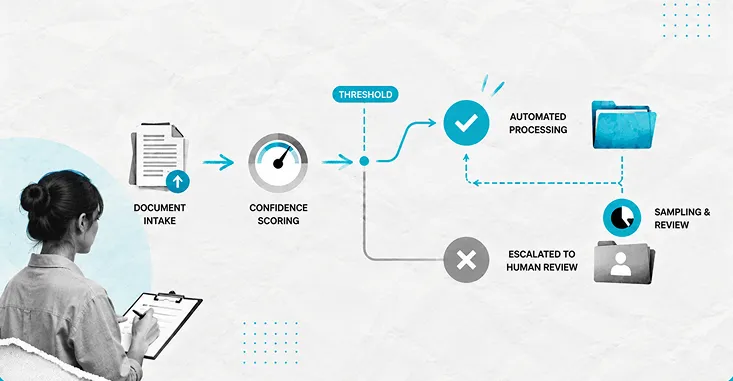
Agentic systems differ in one specific way that is worth stating precisely, because the marketing around it is vague. They classify and extract from context rather than position, they carry a confidence score on each field, and they can be configured to escalate rather than guess when confidence falls below a threshold. That last property is the one that matters, and it is the one buyers rarely ask about.
What honest results look like
Here is the outcome pattern from a legal operations client running SSD work at scale, and it is worth reading for what it does not say.
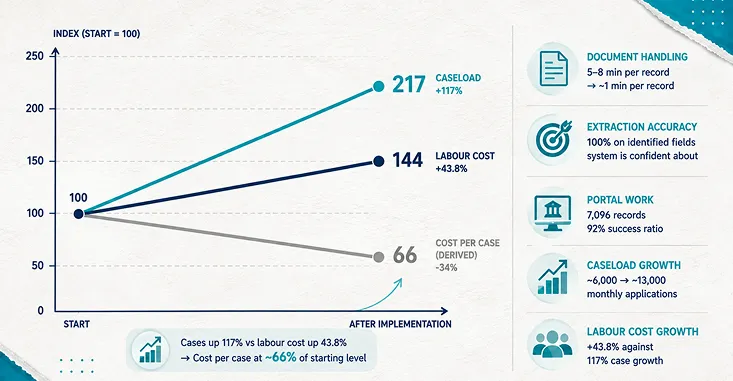
Document handling that took five to eight minutes per record moved to roughly a minute. Extraction accuracy on identified fields reached full accuracy on the fields the system was confident about, with complete visibility into the ones it was not. On portal work, an automated hearing-status retrieval process handled 7,096 records at a 92 percent success ratio. Caseload roughly doubled, from six thousand monthly applications toward thirteen thousand, while labour cost grew 43.8 percent against 117 percent case growth.
Now the part that a case study usually leaves out. A 92 percent success ratio means eight percent did not succeed, and those did not vanish. They arrived in an exception queue, which did not shrink so much as change shape: fewer routine records, a higher concentration of genuinely ambiguous ones, and a review population that needed more skill per item rather than less. Firms that budget for the 92 percent and not the eight percent discover this in month two and conclude the automation underdelivered, when what actually happened is that they staffed the wrong side of it.
The caseload and labour figures are the ones a buyer should press on, because the ratio is the whole argument. Cases up 117 percent against labour cost up 43.8 percent implies cost per case at roughly 66 percent of its starting level, a reduction near 34 percent. That is a real number and it is also a two-point comparison, which means it carries whatever else changed in the same period. A buyer should ask what else changed. The defensible version of this claim is that automation was necessary to absorb that growth without proportional hiring, not that automation alone produced the whole wedge.
The arithmetic, and where it breaks
The following model is illustrative. It uses a plausible fully-loaded cost rather than any client’s actual rate, and its purpose is to show which assumption the case actually rests on.
Take a document specialist at $72,000 fully loaded. Annual gross hours of 2,080, less roughly 28 percent for leave, holidays, training, and non-productive administration, gives 1,497.6 productive hours, or 89,856 productive minutes. That puts cost at $0.8013 per productive minute. Using productive hours rather than gross is the difference between a model that survives a CFO and one that does not.
At a 6.5-minute midpoint for manual handling, a thousand documents costs 6,500 minutes. Post-automation, assume a minute of residual human time on clean documents, a two percent exception rate consistent with 98 percent extraction accuracy, and 9.5 minutes on each exception, because an exception costs more than an ordinary manual pass rather than the same. That gives 1,170 minutes per thousand documents, a saving of 5,330 minutes or 82 percent, worth $4,270.83 per thousand documents. On a conservative five-minute manual baseline the saving is 76.6 percent and $3,068.91.
The number that decides whether this holds is the exception rate, and the breakeven is not close. At the 6.5-minute baseline, exceptions would have to reach 64.71 percent before automation stopped saving anything. On the conservative five-minute baseline, 47.06 percent. Even if exceptions cost 20 minutes each rather than 9.5, breakeven sits at 28.95 percent and the saving at a 2 percent exception rate is still 78.8 percent. The case is robust to being substantially wrong about exception cost, and it is robust to being wrong about the manual baseline. It is not robust to an exception rate in the tens of percent, which is precisely the failure mode of scripted automation.
So the question to put to any vendor is not what accuracy they achieve. It is what their exception rate was at month six on documents they had not seen during implementation, and what the exceptions cost to clear.
Governance, written down before deployment
Two public frameworks are worth using here, not because either is binding on a law firm but because both give a firm a vocabulary its clients and insurers already recognise.
The NIST AI Risk Management Framework is explicitly intended for voluntary use, and it is currently being revised as part of the White House AI Action Plan, which is a reason to treat it as a structure rather than a checklist to certify against. The AI Playbook for the UK Government, published 10 February 2025 by the Government Digital Service, sets out ten principles for civil servants deploying AI and expands the Generative AI Framework published in January 2024.
What that translates to in an SSD operation is narrower than either document: a written confidence threshold per field type with a stated reason for the number, an audit trail capturing what the system read and what it decided, a named human owner for each exception category, and a sampling regime on the automated output rather than only on the exceptions. The sampling point is the one firms skip. Reviewing only what the system flagged tells you nothing about what it got confidently wrong.
There is a professional-responsibility layer underneath this that needs documenting by your own counsel rather than by a vendor. Delegating document review to a system does not delegate the duty of competence, and the supervision obligation attaches to the lawyer regardless of what the workflow diagram says.
What to do before buying anything
Measure your own baseline first, because every number above is someone else’s. Time a real sample of document handling end to end, including the filing step people forget to count. Establish what proportion of your denials are technical rather than medical. Count how many of your portal interactions are status checks that produced no action.
Then size the fast lane against your own geography rather than the national 8.40 percent, since the state spread runs from under six percent to nearly thirteen.
If document handling is not among your three largest non-attorney time costs, this is not your first automation project, and a vendor telling you otherwise is selling from a template. If it is, the model above suggests the case is strong enough to survive being substantially wrong about the inputs, which is the only kind of business case worth putting in front of a partnership.
You can read the full operational detail, including the deployment sequence and the exception-handling design, in our SSD whitepaper, and the agentic AI for SSD firms page agentic AI for SSD firms sets out how the components fit together. If your concern is narrower than SSD specifically, the intelligent automation in the legal sector intelligent automation in the legal sector piece covers safe adoption patterns more generally, and bot counts are a vanity metric bot counts are a vanity metric is the argument for measuring outcomes rather than deployments.