
The budget got approved on a Tuesday. By Thursday the CFO had sent a two-line email to the CX Director: happy with the case, one thing for the next board meeting, when do we see the return. No hedging language requested. A month.
That email is harder to answer than it looks, and not because the answer is unknowable. It is hard because the honest answer depends almost entirely on decisions that have not been made yet, and most of them are not technology decisions.
So let us deal with how long to see ROI from CXone implementation properly, with the actual published numbers rather than vendor comfort language.
Here is our position, and it is a little uncomfortable for parts of our own industry: if someone tells you CXone ROI takes eighteen months, they are either sequencing the build wrong or they have no KPI baseline to measure against. Eighteen months is not a technical constraint. It is usually a symptom of a programme that automated the wrong things first, or one that cannot prove improvement because nobody captured the starting position.
The two numbers NiCE publishes, and why they are eleven months apart
This is worth looking at directly, because both figures are real and both come from NiCE.
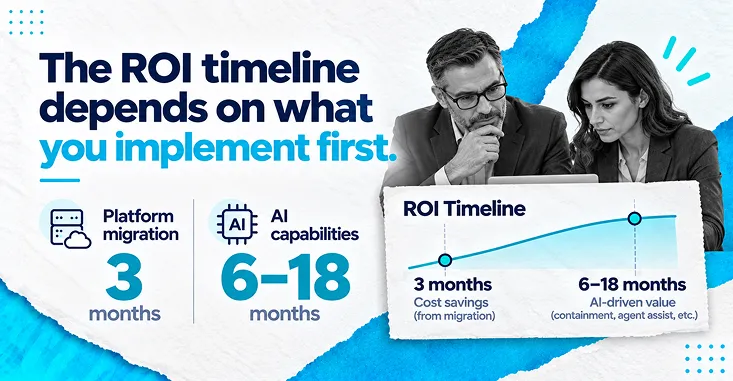
The Forrester Total Economic Impact study NiCE commissioned found a payback period of just over three months for a composite 1,100-seat organisation migrating from on-premise, with a three-year total benefit of $25.9 million and net present value of $19.8 million.
NiCE’s own current guidance on generative AI in customer service puts enterprise deployments at 320 to 650 percent ROI with payback periods of six to eighteen months.
Same vendor. Very different windows. Neither is wrong.
The three-month figure comes from migration economics. When you move off on-premise infrastructure, a large block of cost disappears on day one: hardware refresh cycles, telephony maintenance contracts, the licensing you were carrying, the internal headcount maintaining all of it. That saving does not depend on anyone changing how they work. It lands as soon as the old estate is switched off.
The six-to-eighteen-month figure covers AI capability layered on top. Containment improvement, agent assist, automated quality management. That value is real and generally larger, but it depends on configuration, on knowledge quality, and on people changing behaviour. It takes longer because it should.
So when a partner quotes you a single ROI timeline, the first question back is: which of those two things are you actually describing?
See how PAteam approaches CXone delivery.
Where the eighteen months usually goes, and it is not the platform
We get called into stalled programmes often enough to see the same pattern.
The build sequence gets set by what is interesting rather than what pays. So the programme opens with an ambitious AI use case, or a full reporting rebuild, or a channel expansion into somewhere the volume does not yet justify. Meanwhile the basics that would have produced measurable savings in the first quarter sit in phase three of the roadmap.
Routing logic is the clearest example. If contacts are landing with agents who cannot resolve them, every downstream metric suffers, and fixing that is not glamorous work. It is a fortnight of disciplined design against real contact data. It moves average handle time and first contact resolution faster than almost anything else you could build, and it is routinely deferred because it feels like plumbing.
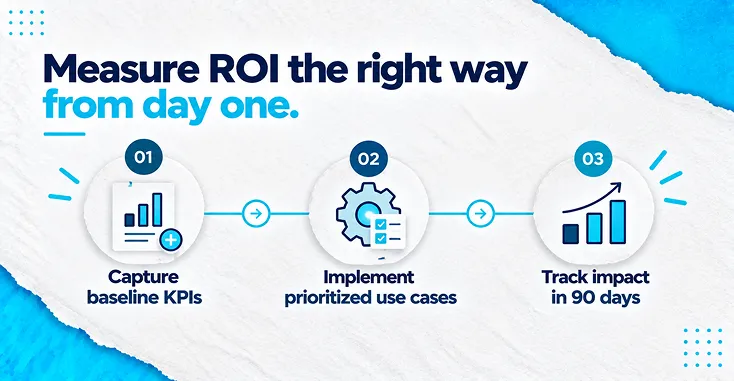
The second thing that eats months is the absence of a baseline. Nobody captured pre-migration AHT, ACW, FCR, containment, or cost per contact with any rigour. So the programme delivers genuine improvement and then spends a quarter arguing about whether it happened, because finance and operations are working from different numbers. That is not an ROI delay. That is a measurement failure wearing an ROI delay costume.
Think of it as renovating a building with no photographs of what it looked like before. The work is real. Proving it to the person who signed the cheque becomes an argument rather than a report.
What the total cost of ownership actually includes
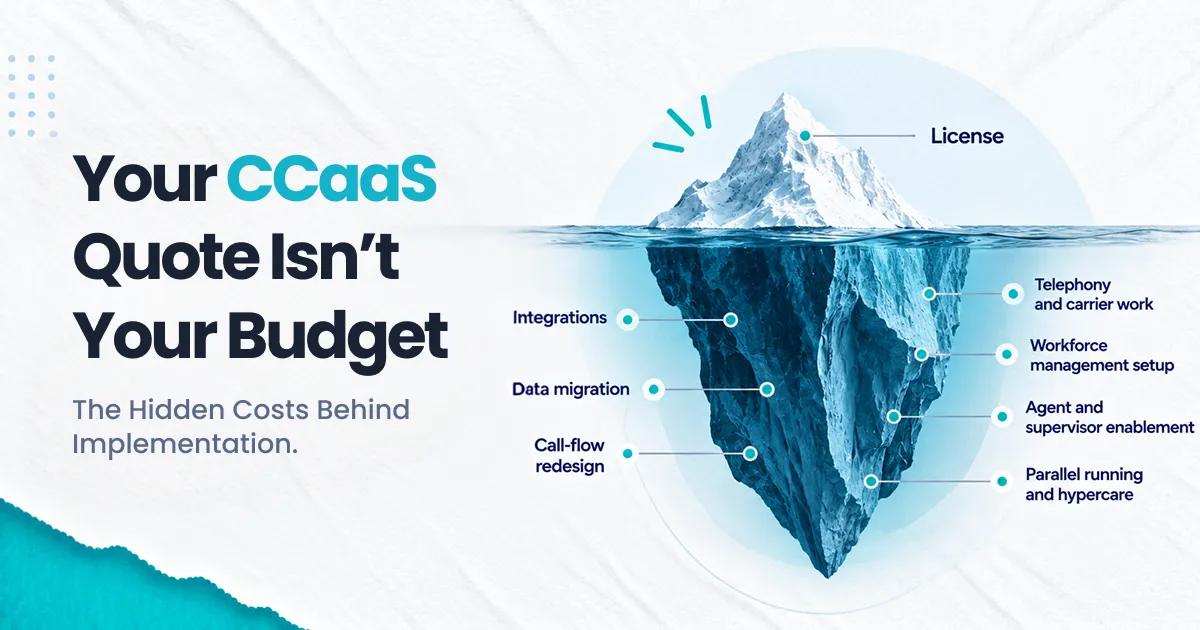
A CFO cannot assess payback against licence cost alone, and most business cases are built on exactly that. Here is the fuller picture, using publicly listed figures.
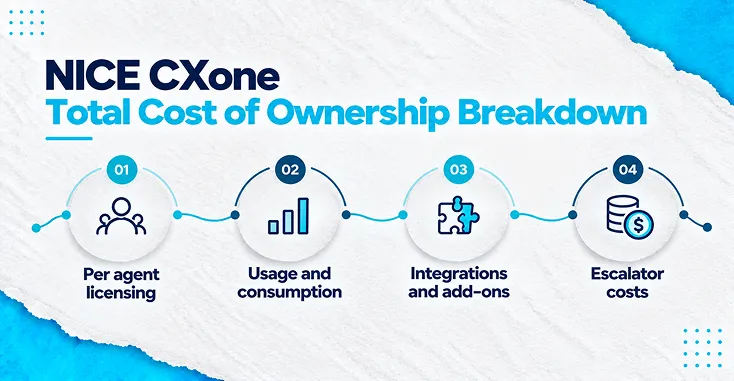
Published CXone Mpower per-agent pricing currently runs from around $71 per month for a digital agent, roughly $94 for voice, and about $110 for omnichannel, with higher tiers listed up to around $249. Independent procurement benchmarks describe the model as per agent plus usage, typically on three-year contracts, with discounts of twenty to forty percent off list for enterprise volume and annual escalators in the four to seven percent range.
Then the lines that are usually missing from the first draft of the business case.
Usage-based costs on top of seats, particularly telephony minutes and AI consumption, which scale with volume rather than headcount. Implementation and configuration, which is where partner cost sits. Integration work into your CRM and ticketing systems, which is the single most variable line and the one most likely to be underestimated when legacy systems are involved. Data migration and historical reporting. Training and change management, which is a real cost even though it rarely gets a line of its own. And the annual escalator, which compounds across a three-year term and turns a comfortable year-one number into an uncomfortable year-three one if nobody modelled it.
The offsetting side is usually stronger than the business case claims, because on-premise costs are often distributed across several budgets and never fully attributed. Telephony contracts, infrastructure refresh, on-premise licensing, and the internal engineering time spent keeping it alive. Pull all of that into one number before you compare.
One practical note for the board paper: negotiate the escalator, not just the headline rate. A four percent difference on year-one price is visible. A three point difference on the escalator is worth considerably more across the term and attracts far less negotiating attention.
What we build in the first ninety days, and why that order
The sequence is the lever. Build for measurable operational impact first, then layer capability on a foundation that is already producing numbers.
What to take from this
There is no single CXone ROI timeline, there are two. Infrastructure savings from leaving on-premise arrive almost immediately, and NiCE’s commissioned Forrester study puts that payback at just over three months. Operational and AI-driven gains take six to eighteen months, which is NiCE’s own published range. Know which one your business case is actually built on.
Eighteen months is usually self-inflicted. It comes from building the interesting things before the things that pay, and from having no agreed baseline to measure against. Fix the sequence and capture the baseline and the timeline compresses substantially.
Expect the first six weeks to look worse. Put that in the board paper before launch rather than explaining it afterwards, and set week twelve as the first honest measurement point.
If your CFO is waiting on a date, the useful next step is a modelled answer built on your actual seat count, contact volume, and current infrastructure cost.
Sources:
- The Total Economic Impact of NICE inContact CXone (Forrester Consulting, commissioned by NICE)
- NICE inContact CXone Delivers Big Payoff of $25.9 Million
- Generative AI Customer Service ROI: Building the Business Case (NiCE)
- CXone Packages and Pricing (NiCE)
- NiCE CXone Pricing Plans (TrustRadius)
- NICE CXone Pricing: What Enterprises Actually Pay (VendorBenchmark)