
A customer writes in: “I moved last week, my delivery is still going to the old address, and I need the refund for the one that never arrived.”
The chatbot replies with three help articles and a link to the returns page. The customer types “agent.” Four minutes later, a human starts from scratch.
The bot did exactly what it was built to do. It was never built to fix anything.
That gap is the real answer to the agentic AI vs chatbot question. Here is what we actually think: much of what is sold as an AI agent today is a chatbot with better language skills. The test is not how well it talks. The test is whether it can finish the job across your systems.
This post explains how agentic AI differs from chatbots and RPA, where each one fits, and how to tell which one you are really being sold.
Chatbots and RPA: what each does well, and where each stops
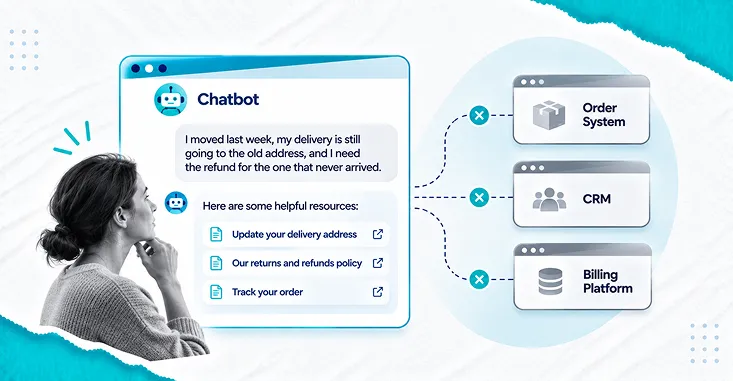
A chatbot produces words. Older ones follow scripted menus. Newer ones use language models to understand the question and write a natural reply. Either way, the output is a response.
That is useful for:
- Answering common questions from a knowledge base
- Collecting details before handing over to a person
- Handling simple, repeated queries at any hour
It stops at action. A chatbot can explain how refunds work. It cannot check the order, confirm the delivery failed, issue the refund and update the case, unless someone has wired each of those steps in by hand.
RPA uses digital workers to carry out fixed tasks inside systems: copy this field, check that status, update this record. When the process is stable and the inputs are clean, digital workers are fast, accurate and easy to audit.
Their weakness is variation. A digital worker follows the steps it was given. If the customer phrases a request in a new way, or a screen changes, or the case needs a judgment call, it stops or fails.
Agentic AI vs chatbot: the difference is that it decides and acts
Picture three people in your service operation:
- A chatbot is a receptionist who knows every answer but has no access to the back office.
- RPA is a clerk who follows a checklist perfectly but cannot take a call.
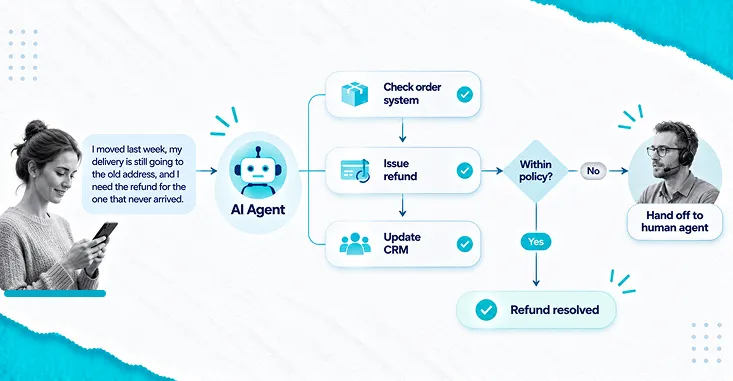
- Agentic AI is a case handler who takes the call, works out what needs to happen, does it across the systems, and passes it to a person when the decision is above their limit.
Technically, an agentic AI system is given a goal, not a script. In a contact center, that goal might be “resolve this refund request within policy.” To get there it can:
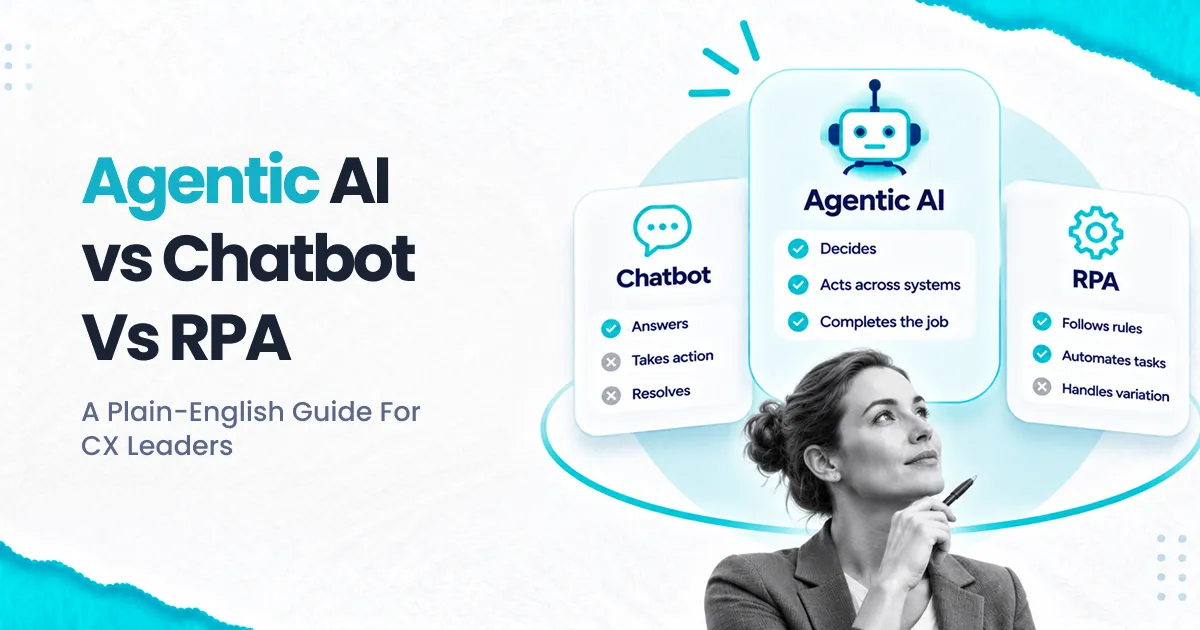
Here is how the three compare:
| Chatbot | RPA | Agentic AI | |
|---|---|---|---|
| Main output | Answers | Completed fixed tasks | Completed goals |
| Takes action in systems | Only if wired in step by step | Yes, by fixed rules | Yes, by choosing which tools to use |
| Handles messy input | Partly | Poorly | Well, within limits |
| Needs every step written in advance | Scripted bots do | Yes | No, but needs guardrails |
| Best fit | Simple, repeated questions | Stable, high-volume processes | Variable, multi-step cases |
The honest limits of agentic AI
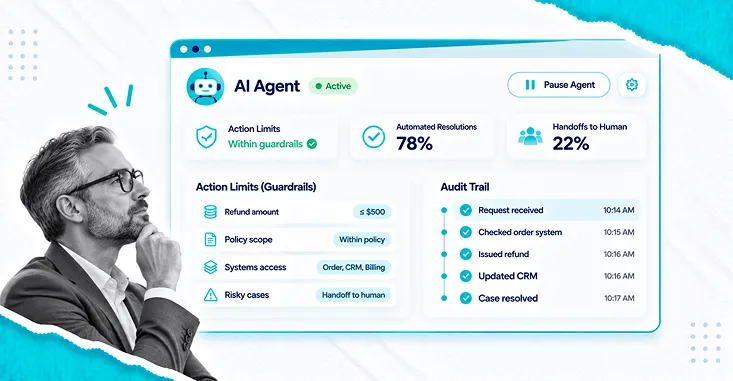
Picture a Contact Center Director taking a call at 7 a.m. because an AI agent issued the wrong refund to a batch of customers overnight. They do not need a lecture on autonomy. They need to know who set the limits, what the agent was allowed to do, and how fast it can be switched off.
That is why guardrails belong in the design, not in an add-on:
- Action limits. What the agent can approve alone, and what needs a person.
- Human handoff. A clear route to a live agent, with the full context passed across.
- Audit trail. A record of every decision and action, readable by a non-technical reviewer.
- Monitoring and a pause control. Someone owns it, and they know how to use it.
And here is the part a vendor trying to close a deal might skip. Agentic AI is not the right tool for every workflow. If the process is stable and rule-based, RPA is cheaper to build, easier to audit and faster to deploy. We will tell you that even though agentic AI is the more exciting sale. Using the heavier tool on a light job adds cost and risk for no extra return.
Four questions that show what you are really being sold
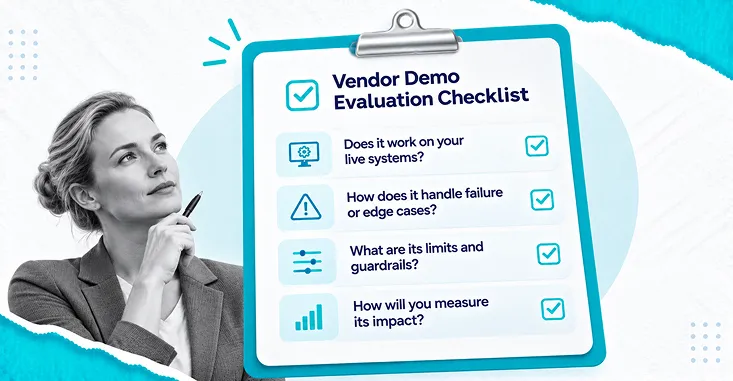
Ask any vendor to do four things:
We go deeper on this in our guide to evaluating agentic AI vendors for CX. Analyst firms track how quickly this category is changing, so treat any claim of full autonomy with care.
Matching the tool to the process
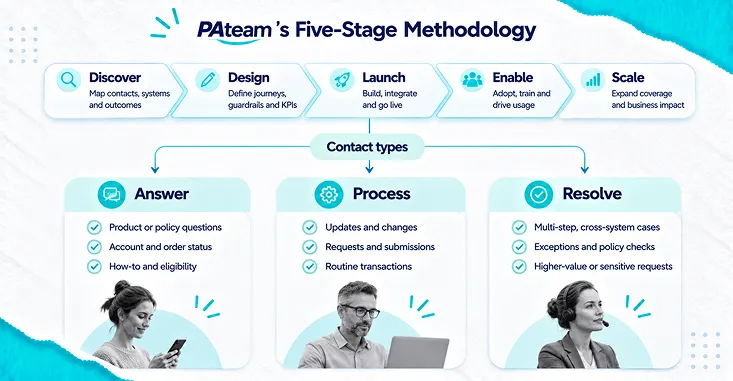
At PAteam we match the tool to the process, using Discover, Design, Launch, Enable and Scale. In Discover we sort your contact types into three groups: answer it, process it, resolve it. That decides whether a chatbot, digital workers or an AI agent is the right fit. Often it is a mix, with the AI agent handling the conversation and digital workers carrying out the fixed steps behind it.
The outcomes follow the fit. Containment has improved by 10% in our deployments. For Bridge Marketing, an e-commerce client, 20,000 monthly inquiries are now resolved in under 60 seconds. You can see how we approach this on our agentic AI service page.
Conclusion
If you remember one thing, ask what the system does after it answers. A chatbot stops at the reply. RPA runs a fixed script. Agentic AI works toward a goal across your systems, within limits you set.
Most contact centers need a mix. The skill is in matching each type of contact to the right tool, and in setting guardrails before anything goes live.
Frequently Asked Questions
Straight answers to the questions a skeptical CFO or COO tends to ask after the demo.