
CCaaS Implementation Cost: The Hidden Line Items to Budget For

Shruti Sharma

Shruti Sharma

Author

CCaaS Implementation Cost: The Hidden Line Items to Budget For

The license quote was approved in March. By September, the project owner is back in front of finance, explaining why the CCaaS implementation cost looks nothing like the number on the original slide.

Nobody lied. The quote covered seats, usage and a go-live date. It did not cover the integrations nobody had mapped, the call flows nobody had documented, or the three weeks of agent training nobody had scheduled.

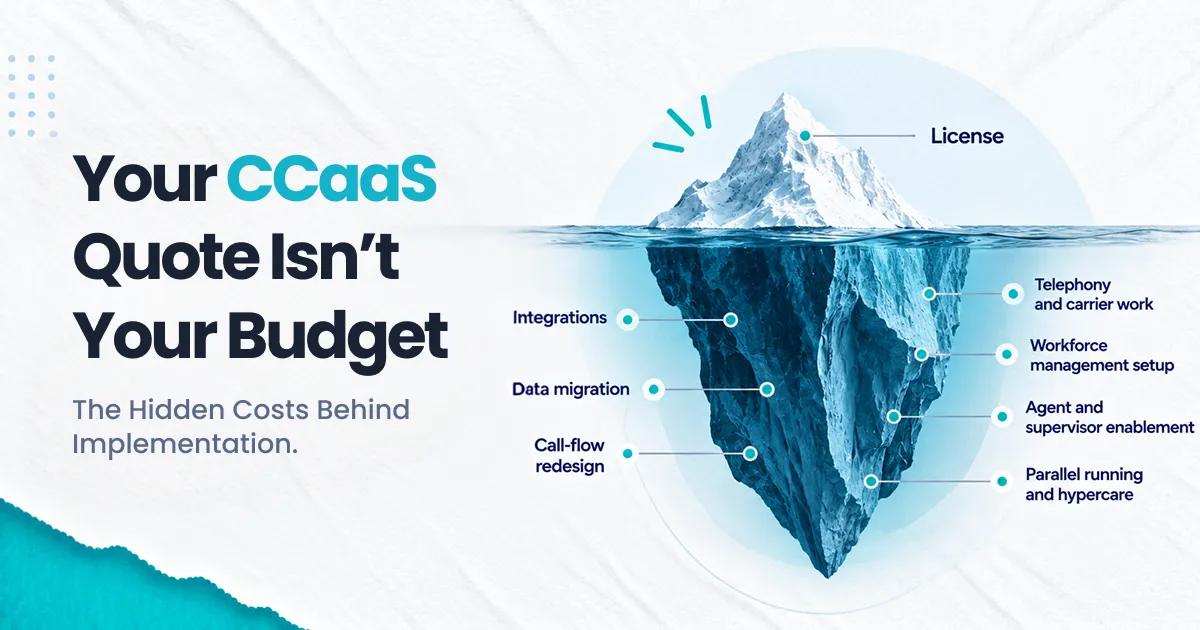
Here is what we actually think: the license is the one line in a CCaaS budget you can predict. The lines that hurt are the ones nobody priced.

This post walks through the cost lines most vendor quotes leave out, shows you how to budget for each, and ends with the questions to ask before you sign. It is written for the VP or Director who has to defend the number twice: once before approval, and once after go-live.

A vendor quote is a starting point, not a budget
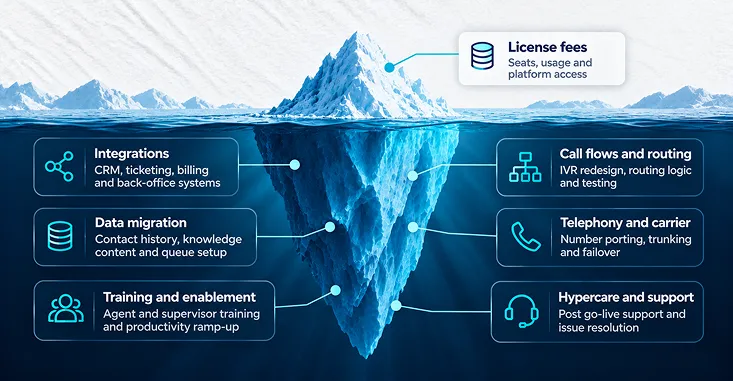
Ccaas Implementation Cost Shown As An Iceberg, With License Fees Above The Waterline And Integration, Data, Training And Support Costs Below

A quote covers what the vendor sells. A budget has to cover what the project needs. Those are two different lists.

A typical quote covers:

  • Platform licenses and agent seats
  • Usage and telephony charges
  • Standard support
  • A defined onboarding scope

A typical quote does not cover:

  • Your integrations and the state of your systems
  • Your data, your call flows and your internal processes
  • Your people’s time
  • Whatever you discover in week six

Think of a kitchen renovation. The quote lists the oven, the cabinets and the countertop. It does not list the plumbing that has to move, the wall that turns out to be load-bearing, or the weeks you spend cooking on a hot plate. None of that surprises the builder. It only surprises you, because nobody put it on the page.

Seven CCaaS implementation cost lines your quote probably misses
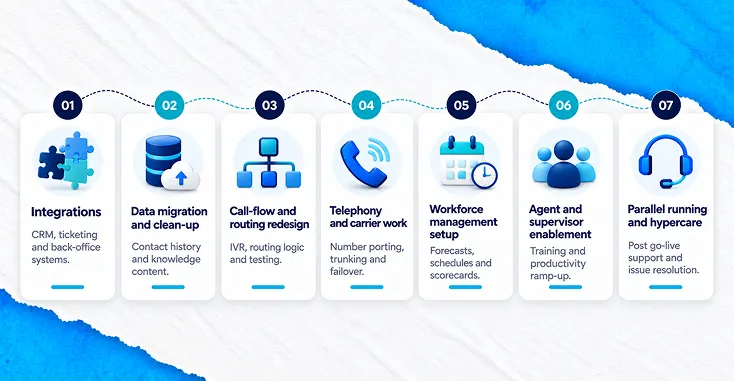
Checklist Of Seven Ccaas Implementation Cost Lines Including Integrations, Data Migration, Call Flows, Telephony, Wfm, Training And Hypercare

Work through these before you approve a number. Each one needs a line item, an owner and an estimate.

Integrations.

CRM, ticketing, identity, billing and back-office systems. Every system an agent touches during a call is a candidate. Some have clean APIs. Many do not. Check what the platform supports natively, and start with NICE's own documentation.

Data migration and clean-up.

Contact history, dispositions, knowledge content, queue and skill definitions. Moving messy data into a new platform gives you a new platform with the same mess.

Call-flow and routing redesign.

Lifting and shifting old IVR and routing logic carries old problems across. A proper redesign takes workshops, testing and sign-off from several teams.

Telephony and carrier work.

Number porting, trunking, failover and parallel running. Carrier timelines are rarely yours to control.

Workforce management and quality setup.

Forecast tuning, schedules, scorecards and evaluation forms. These tend to be configured last and need the most iteration.

Agent and supervisor enablement.

Training hours are a cost. So is the productivity dip while people learn a new desktop. Budget for both.

Parallel running and hypercare.

The weeks after go-live when you need extra eyes on queues, reporting and edge cases. Plan for it, or it plans for you.

Not every line will be large for every business. Every line will be more than zero.

Where the overrun shows up, and who has to explain it
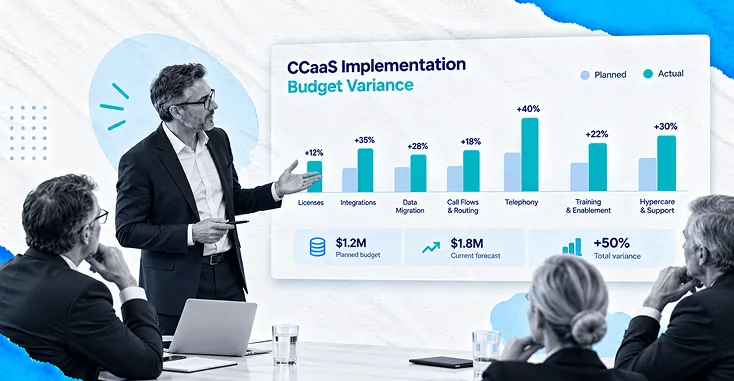
Operations Leader Presenting A Budget Variance Chart To Finance Executives In A Ccaas Implementation Cost Review

Picture a VP of CX Operations in a month-six budget review. The project is eight weeks behind. The CFO has one question: is the extra spend a one-time cost, or will it recur every month?

If the answer is “the vendor needed more time,” the project loses credibility, whatever the platform can do.

The way out is to classify every cost line before you start:

  • One-time: integration build, migration, redesign, training, hypercare
  • Recurring: licenses, usage, carrier, support, ongoing tuning
  • Avoidable: rework caused by unmapped systems or unclear scope

Finance can plan around the first two. They stop trusting a project when the third arrives unannounced. If you can show that a cost was identified, owned and classified up front, the conversation is about timing. If you cannot, it is about blame.

How to build a budget that survives the month-six review

1

Map every system the contact center touches.

Ask agents, not only IT. They know the screens that never made it onto the architecture diagram.

2

Get the vendor's assumptions in writing.

How many integrations, sites, call flows and channels. A quote without assumptions is a guess with a logo on it.

3

Price the people cost.

Training hours, project team time and subject-matter experts pulled off the queues.

4

Tie contingency to named risks.

“Fifteen percent, just in case” tells finance nothing. “Contingency for the CRM integration, because the API is undocumented” tells them what to watch.

5

Define what done means.

Include hypercare and the handover to your own team, not only the go-live date.

Here is the uncomfortable part, and it applies to us too. No partner can give you a reliable total before they have looked at your estate. Anyone who does is guessing. That is why we start with Discover, and why we will sometimes tell a client to delay go-live by a quarter rather than launch on data that is not ready. It is the less exciting answer. It is also the cheaper one.

What a properly scoped CCaaS project looks like
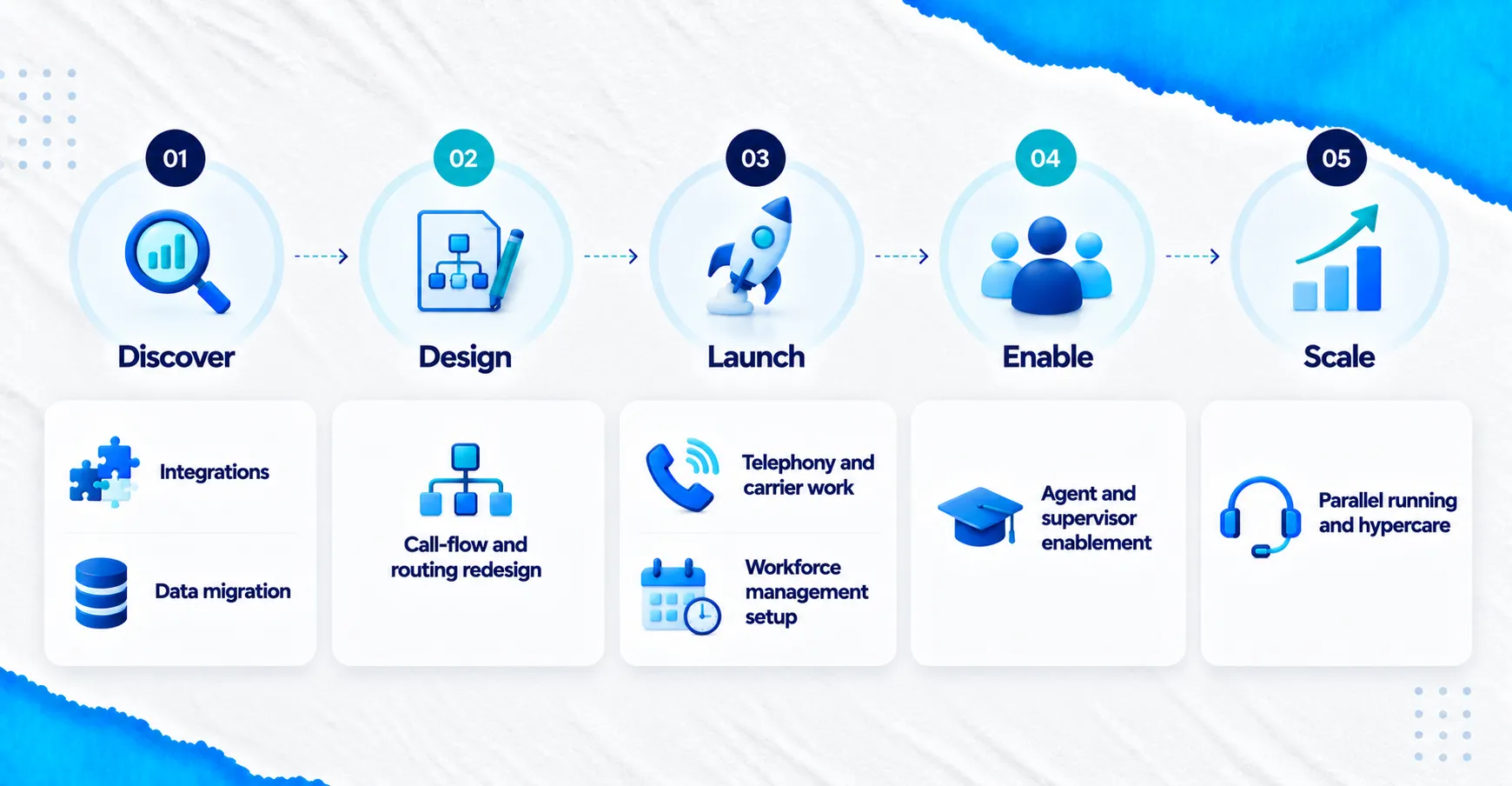
Pateam Five-Stage Methodology, Discover, Design, Launch, Enable, Scale, Mapped To Ccaas Implementation Cost Lines

Good scoping puts every cost line where you can see it. This is how we structure that at PAteam, as a certified NICE CXone implementation partner:
Discover

system map, data review and call-flow audit. This is where integration and migration costs get real numbers.

Design

routing, WFM and quality design, with an owner for each decision.

Launch

build, test, parallel running and hypercare, priced up front.

Enable

agent and supervisor training run as a workstream with its own plan, not a footnote.

Scale

tuning and optimization after go-live, so the platform keeps paying back.

The result is a budget with fewer surprises. On our engagements, ROI payback is typically under 6 months and cost-to-serve has been reduced by 15%. Those numbers hold because the cost side was honest from the start. If you want to see what happens when it is not, read why CXone implementations fail.

Conclusion

A CCaaS budget fails in one of two ways. The number is too low, or the number is right and nobody can explain it. Both are fixable before you sign.

Take three things from this post:

  • The license is the predictable line. Integration, data and people costs are where plans break.
  • Classify every line as one-time, recurring or avoidable, and give each an owner.
  • Ask for assumptions in writing, and tie contingency to named risks.

If you are partway through an evaluation and the number feels too clean, that is worth a conversation. Book a 30-minute working session with PAteam. We will walk through your estate, list the cost lines your quote leaves out, and show you where the payback comes from.

Frequently Asked Questions

Straight answers to the questions a CFO or COO tends to ask after the demo.

How much does a CCaaS implementation cost?

It depends on the number of integrations, sites, channels and call flows, which is why an honest number only exists after discovery. Be wary of any partner who quotes a total before looking at your estate. Ask for a line-by-line breakdown instead. On PAteam engagements, ROI payback is typically under 6 months, but that depends on a clean baseline.

A fixed price protects you only as far as its assumptions go. When discovery reveals an undocumented integration or messy data, an assumption breaks and a change request follows. Ask for the assumptions list in writing before signing. At PAteam, we use Discover to test those assumptions first, so surprises show up before build starts, not during it.

Over a three-year view, it depends on your estate. For a single-site team with a clean CRM, the license tends to dominate. For multi-system enterprises, the integration, migration and enablement work around it can match or exceed it. Model both over three years, not just year one, so recurring and one-time costs sit side by side.

Skip the flat percentage. Tie contingency to named risks: an undocumented CRM API, unclean contact history, a carrier porting window. Review each risk at the end of Discover and again before Launch, and release the money as risks close. That gives finance something to track and gives your project team a reason to resolve each risk early.

Sometimes, yes, and it is the answer vendors tend to avoid. Launching on unclean data or untrained supervisors usually costs more in rework than a one-quarter delay saves. We will tell clients that even when it moves a milestone. Use a readiness review at the end of Design to make the call, not the calendar.

Proof & Testimonials

Trusted by teams building scalable automation

FedEx Express Europe

PAteam's deep architectural expertise helps us execute current opportunities while strategically planning for the future. Their flexibility has been key to our shared success.

— Andrzej Srebro

IT Manager

The Wasserstrom Company

PAteam significantly improved our productivity. By handling day-to-day development, they've enabled our employees to focus on high-value exceptions.

Michal T. Slominski

EVP, Information Technology

Healthcare Sweden

When an incident threatened our environment, PAteam restored operations with zero downtime. We rely on partners who deliver the highest level of service.

Director

Healthcare, Sweden

MI Homes

PAteam improved our productivity tremendously. Their automation expertise in streamlining data entry allows our team to focus on volume growth.

Director

MI Homes

Kirkendall Dwyer

PAteam makes complex solutions simple. They took my vision and turned it into an automated process that worked better than imagined.

Mason Johnson

Kirkendall

BPO Sector

If you want to avoid the pitfalls of building a scalable automation environment, PAteam are the masters at making that vision a reality.

Manager

Business Process Outsourcing

Unlock the Future of Work

One platform. Copilots that elevate people. Automation that scales everywhere. Let’s design a smarter, seamless operation for your customers, your teams, and your business.

unlock the future work
Scroll to Top